Sinlaku’s 72‑hour assault prompts full federal mobilization in Guam and CNMI


By Bryan Manabat
Saipan— The full might of the federal government's emergency response is now in the Northern Mariana Islands after Super Typhoon Sinlaku devastated the islands during a 72‑hour assault from late Tuesday through Wednesday, according to the Federal Emergency Management Administration.
Anticipating the urgent requirements of the affected islands, FEMA and the U.S. Army Corps of Engineers Honolulu District pre-positioned critical assets on Guam to ensure the fastest possible post-storm response.
This strategic partnership allowed operational readiness well ahead of landfall. On-site corps personnel are now collaborating with federal partners to lead the ground response.
"The strength of our response to Super Typhoon Sinlaku lies in our steadfast partnership with FEMA and our territorial partners,” said Lt. Col. Adrian O. Biggerstaff, USACE Honolulu District Commander. “We stand shoulder-to-shoulder with the resilient communities of CNMI, remaining fully committed to providing the support needed to begin recovery."
FEMA has tasked the USACE Honolulu District with several vital life-sustaining missions. A USACE's Temporary Roofing Planning Cell of four personnel is currently deployed to conduct post-storm reconnaissance and assess the viability of metal roof replacements in Saipan.

Robert Fenton, FEMA Region 9 administrator, who arrived in the CNMI to oversee the response, said the agency’s immediate focus is on life‑safety operations.
“Right now, we need to make sure we're taking care of those immediate needs. We need to make sure people have food and water, that we have emergency power, that the medical… systems [are] going, that we get communications back up here, and we'll do that as a team,” he said at Friday's press briefing.
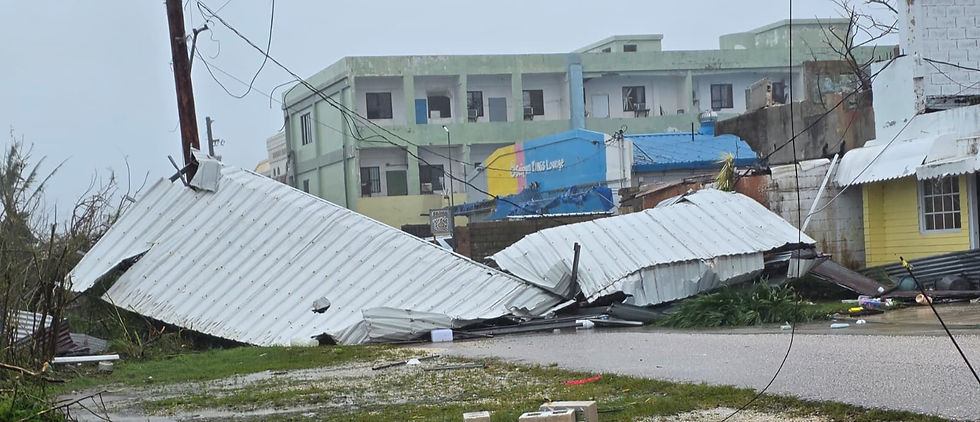
Federal officials said Sinlaku’s slow‑moving, 500‑mile‑wide circulation lingered over the Marianas far longer than a typical typhoon, producing prolonged destructive winds, heavy rainfall and widespread failures across power, water and communications systems.
Fenton noted that the storm’s duration created both physical and mental strain for residents.
CNMI Gov. David Apatang said the government is considering extending shelter operations to allow residents to stay longer until they are ready to return to their homes.
FEMA pre‑deployed teams before landfall and shifted north as Sinlaku’s track changed. A multi‑stage supply chain is now moving equipment from the U.S. mainland to Hawaii, Guam and into the CNMI by air and sea. Incoming resources include generators, bottled water, meals, tarps and tactical communications equipment.
Roughly 500 federal personnel are already operating between Guam and the CNMI, with more arriving in the coming days, including Red Cross shelter teams. Federal partners include the Department of Energy, the U.S. Army Corps of Engineers and its 249th Power Battalion, the EPA, the U.S. Coast Guard, Health and Human Services and national communications units.
Fenton said FEMA’s top priority is restoring water systems and ensuring safe drinking water.
“The good news is that we've done a lot of planning with CNMI over the years. We're well aware of their water system, the wells. We know what generators actually power their wells," he said.
"Some of those might have been damaged in this event, but we will make sure that we do everything to make sure that critical facilities, such as water and other facilities, come back online as quickly as we can," he added.
Bottled water shipments are already moving.
“Until the water comes back safe, we are moving significant amounts of bottled water this way, so that we can distribute it," Fenton said. "We have teams set up to go to Tinian and Rota. So it's not just here on Saipan. We'll have teams that go to every location, and they'll stay there with them and help them bring those resources in.”
Fenton said federal power teams are assessing and installing generators.
“We have generators set up already for some. In some cases, we had generators we purchased at previous events, so there's redundant power here," he said, adding that more generators are on their way to Saipan.
"We will start hooking those up based on the priorities set by the governor and installing those as soon as we can. It takes a little bit of time to do that," Fenton said.

Fenton said FEMA brought equipment and specialists aboard his aircraft to restore communications, while national communications teams are assessing short- and long-term fixes.
“We know the tower went down, so we've already brought with us the stuff to get the tower back and operational," he said.
“We have our mobile emergency response system here that does tactical communications during disasters all over the country. They're here with all their equipment, supplies to put up temporary towers, antennas and all those kinds of things to get the system going," Fenton said.
President Donald Trump's emergency declaration gives Fenton broad authority to manage federal disaster response.
ADVERTISEMENT

Gov. David M. Apatang said water distribution is the commonwealth’s most immediate concern.
“We need to get water out to our people in the community. Power can come later. But the most important issue is to get water out to our community, because we don’t want to have any epidemic out there, especially our people in the shelter," the governor said.
ADVERTISEMENT

He said CUC is working to restore wells, but fuel shortages are slowing progress.
“Everybody’s running around looking for diesel right now, trying to get the service station open so we can give our people a chance to fill up their vehicles or generators or whatever," he added.
The CNMI is requesting additional labor support to speed up the clearing of typhoon debris.
“We instructed our people to start cleaning up, go out and start removing debris (and to) work with public works, CUC and DPW. The mayor’s office, especially, is very active," the governor said.

Subscribe to
our digital
monthly issue