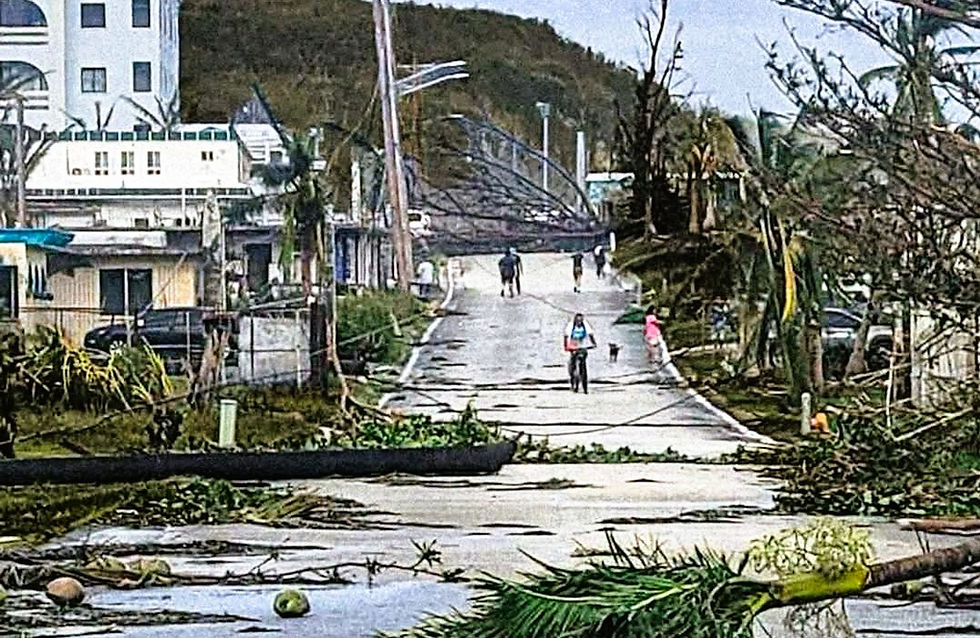
Guam calls for moratorium on seabed mining, sees growing opposition against seabed raid


By Jayvee Vallejera
Any adverse impacts from leasing the Northern Mariana Islands' outer continental shelf for seabed mining will likely affect a wider area, including Guam, according to the Bureau of Statistics and Plans.
Lola Leon Guerrero, the bureau's director, noted that the proposed mining site, as outlined by the Department of the Interior’s Bureau of Ocean Energy Management, is only about 128 nautical miles from Guam, near enough so that any negative impacts will likely disturb the territory.
“Such an impact could pose a significant threat to the biodiversity of the Mariana Trench and the surrounding seamounts, which are globally recognized hotspots, and could consequently compromise the ecosystem function within Guam's exclusive economic zone,” Leon Guerrero said in her written testimony read by Edwin Reyes, BSP administrator, at a public hearing on Wednesday.
BSP was among the several government agencies that called for a moratorium on deep-sea mining in the region, reinforcing Guam's unified position against the federal plan to exploit minerals in the waters of the Marianas.
The 38th Guam Legislature is expected to hold an emergency session on Friday to deliberate a resolution reaffirming Guam's call for a moratorium on deep-sea mining in the region and objecting to leasing underwater lands off the CNMI coast for seabed mining.
The legislature seeks to adopt Resolution 132-38 before the Jan. 12 expiration of the public comment period for the Bureau of Ocean Management's lease plan.
Wednesday’s packed public hearing, presided over by Terlae, received oral and written testimony in favor of Resolution 132-38, introduced by Sen. Therese Terlaje.
Protesters joined the legislative proceedings, carrying placards calling for ocean protection.

The issue has come to the fore after the Trump administration signaled a move to shift the United States away from its dependence on other countries for its supply of critical minerals such as cobalt, nickel, manganese and copper, which are needed for making batteries, electric motors, and renewable energy systems.
That is fanning a gold rush for polymetallic nodules—fist-sized lumps of rock that contain these valuable metals and are found scattered on the seafloor. Many private companies are vying to stake out their claims to these underwater riches.
In her written comments, Leon Guerrero warned that deep-sea mining will disrupt the seabed and kick up sediment plumes that could disperse hundreds of kilometers. These plumes, she said, could potentially reach Guam’s coastal ecosystems within a matter of weeks.
These negative impacts, Leon Guerrero said, are a serious threat to the livelihoods of local fishermen and could compromise Guam's food security.
She also noted that BOEM has not provided the scientific evidence, environmental studies or cultural impact assessments required to fully evaluate the environmental and economic impacts of deep-sea mining in this region.
“These documented risks underscore the resolution’s findings regarding the direct and indirect harm to our surrounding waters. In light of these documented and imminent threats, the lack of a comprehensive study by federal agencies is deemed unacceptable,” she added.
A precautionary moratorium is warranted and should remain in effect pending completion of comprehensive environmental, statistical and cultural impact assessments, she added.
Esther Taitague, senior planner with the Guam Coastal Management Program, “respectfully but unequivocally calls on BOEM to categorically reject seabed mining proposals in the region.:
Critical threats to Guam's seabed mining pose irreversible risks to Guam's tourism-driven economy and to the cultural heritage of the CHamoru people. The Marianas Trench and surrounding ecosystems are globally significant treasures of biodiversity and cultural heritage,” she said.
Julian Aguon, an environmental lawyer, said deep-sea minerals are "not as assets to be monetized and mined, but instead as a living archive of culture, history, and memory, and a bounty to be bequeathed to future generations and to a future self-governing Guam."
Chelsa Muna, director of the Guam Department of Agriculture, said that the BOEM’s request for information process “is procedurally deficient and lacks meaningful consultation.”
BOEM first set a 30-day comment period that would have ended on Dec. 12, 2025. Guam Gov. Lou Leon-Guerrero and CNMI Gov. David Apatang requested a 120-day extension. BOEM extended it only up to Jan. 12.
“Even with this extension, the timeframe remains insufficient for full scientific review, community engagement, and intergovernmental consultation,” Muna said.
She also warned that seabed mining poses risks of irreversible harm to deep-sea ecosystems and biodiversity loss.
Angelo Villagomez, a senior fellow at the Center for American Progress, submitted a petition with more than 1,000 signatories from Guam and the CNMI opposing plans for deep-sea mining in the waters surrounding the Marianas.
“This petition joins thousands more across U.S. territories who stand united against unilateral federal proposals that disregard the rights, traditions, and well-being of indigenous and territorial communities,” he said.
Villagomez urged the legislature to advocate for an immediate halt to any plans for deep-sea mining activities in the region and meaningful consultation with island communities, ensuring free, prior, and informed consent.
Kallen Perez, program coordinator for Puti'on Projects, framed the issue as a question of how many opposing comments are needed in order “for this atrocious proposal” to be denied.
She noted that a seabed mining proposal in American Samoa continues to move forward despite overwhelming opposition.
“Was it not enough to irreversibly decimate the Republic of the Marshall Islands with 65 nuclear bombs over the course of a decade? There is no resource on earth capable of satisfying an insatiable empire, not even the Marianas Trench,” she added.

Subscribe to
our monthly
digital edition