


Bavi one of the strongest storms to pass through Marianas


By Mar-Vic Cagurangan and Bryan Manabat
Super Typhoon Bavi pummeled through the Marianas region Monday morning, with its eye passing over Rota, bringing torrential rains and destructive winds that peaked at 180 mph, causing an islandwide power outage on Saipan and throughout southern Guam.
No deaths or injuries were reported. Damage assessment was not currently available.
"Bavi is among the strongest super typhoons to pass through the Marianas," said Landon Aydlett, warning coordination meteorologist, at the National Weather Service Guam.
The strongest to hit the region before Bavi was Yutu, which carried maximum sustained winds of 175 mph in 2018.
A Category 5 storm, Bavi triggered flash floods in Rota, Tinian and several villages on Saipan. On Guam, several roads were impassable due to fallen trees, large rocks and other storm debris.
Strong winds lingered long after Bavi departed the region.
Tropical storm-force conditions are expected to continue overnight but will gradually weaken, with departure sometime in the early morning hours. NWS cautioned that dangerous conditions were expected to persist through Tuesday morning.
"For Guam, sustained winds of 40 to 60 mph, with gusts up to 90 mph, will continue to decrease through tonight. Additional rainfall accumulations of 5 to 10 inches are possible," the Joint Information Office said.
With Guam and the CNMI remaining in COR1, government offices remain closed.
The Office of the Governor of Guam said COR4 will be declared "once we do an initial assessment of the conditions after the storm."
Typhoon-force winds extended 60 miles from the center, while tropical storm-force winds reached 230 miles north and 185 miles south, placing all three islands under severe weather.
In the CNMI, the Joint Information Center said 517 residents remained in emergency shelters Monday morning, instructed to stay in place while Bavi moved west-northwest at 12 mph.
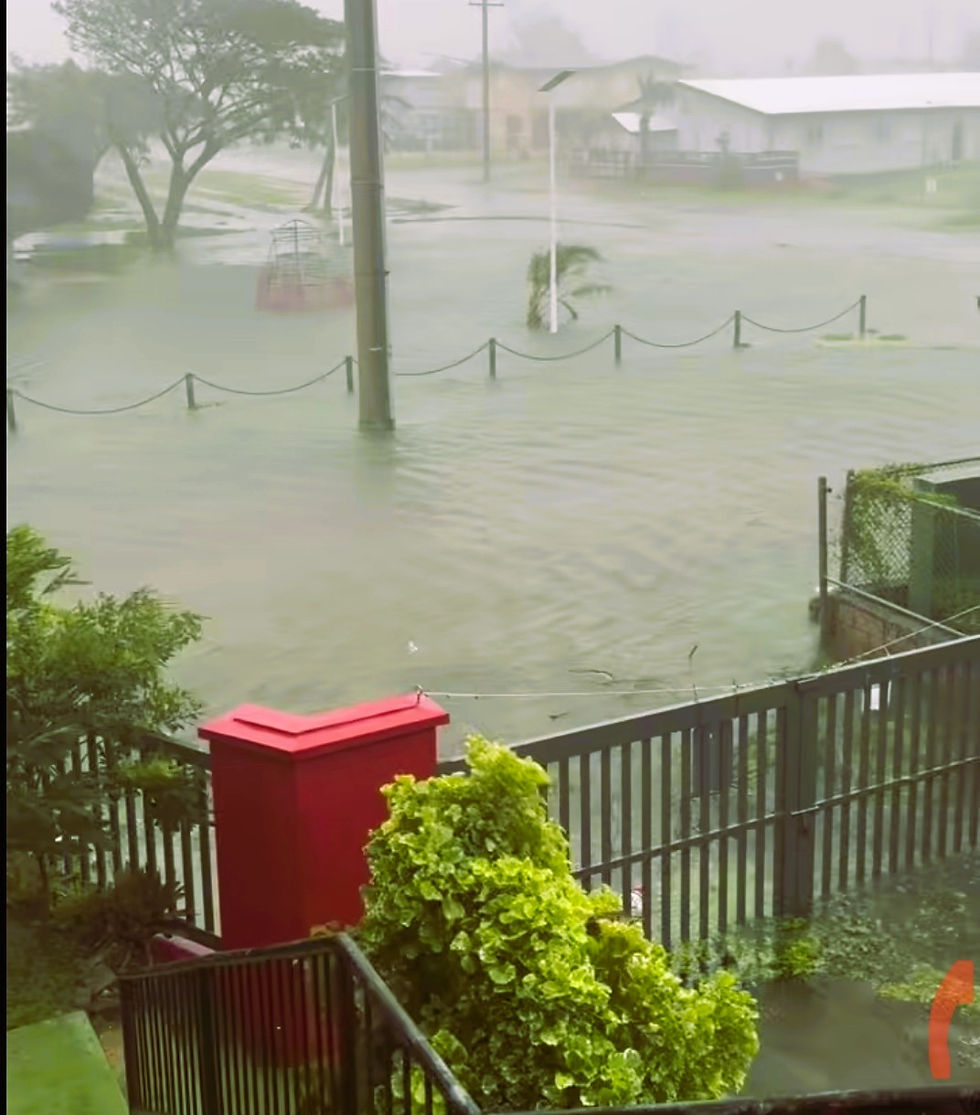
The storm’s maximum sustained winds reached 180 mph, with gusts up to 215 mph and forecasters said the typhoon was expected to maintain its intensity through Tuesday.
On Saipan, shelters housed 150 residents at Marianas High School, 66 at Kobler Elementary School, 69 at Kagman High School, 84 at Garapan Elementary School and 33 at Kagman Community Center.
On Tinian, 61 residents sheltered at Tinian Elementary School and Tinian Middle/High School. On Rota, 25 residents stayed at Dr. Rita Hocog Inos Jr./Sr. High School, while 29 sheltered at the Rota Aging Center.
Some of the sheltered were from the "tent population" who lost their homes after Sinlaku hit in April. About 1,200 households from Saipan, Tinian and Rota received FEMA-provided tents pending reconstruction of homes damaged by Sinlaku.
“A majority of them have sheltered at the designated shelters on the island. We have had teams for the past couple of days helping people with disabilities, the elderly and those with medical needs to take down their tents," said Miguel Dandan, spokesman for the office of the CNMI governor.
“For the rest of the tented population, we encouraged all of them to take down their tents as soon as possible. We opened shelters at COR3, earlier than usual, to give more people time to secure their things and move to a shelter,” he added.
Guam shelters reached 50 percent capacity Sunday night.
ADVERTISEMENT

The Guam Power Authority said its island-wide power system has not experienced any blackout. However, the main transmission lines powering the southern part of the island went down, leaving no power currently serving the south.
"Crews are prepared to immediately begin key assessments and restoration efforts as soon as winds decrease to safe levels. This will begin the recovery phase of the islandwide power system around Guam," GPA said.
Each GPA crew continues to work at least 12 to 16 hours per day once restoration begins.
GPA reported that 25 percent of its distribution feeders remain operational, covering areas such as Andersen Air Force Base, Camp Blaz, Guam Memorial Hospital, and the underground systems in Tumon Row.
"All remaining distribution feeders currently offline will remain out until we begin our assessments and restoration process, once it is safe to do so," GPA said.
The Guam Waterworks Authority crews have begun assessing all accessible points within the water and wastewater distribution systems. GWA is aware of multiple areas reporting low to no water pressure in Agana Heights, Barrigada, Chalan Pago-Ordot, Dededo, Mangilao, Sinajana and Yona.
The CNMI government continued urging residents to remain indoors and avoid travel as hazardous winds and flooding persisted.
Rota sustained the most severe impacts as Bavi’s eyewall crossed the island late Monday morning. Mayor Aubrey Hocog said the Rota Mayor’s Office suffered “major damage” as the storm’s strongest winds tore through the building.
“Yes, major damage,” Hocog said. “The expanded offices are destroyed.”
She said the central office, which serves as the island’s emergency command center, remained standing but “sustained flooding” as the eyewall passed overhead.
Despite widespread structural damage and flooding, officials said the Commonwealth had not recorded any injuries or fatalities as of Monday afternoon.

Subscribe to
our digital
monthly issue


