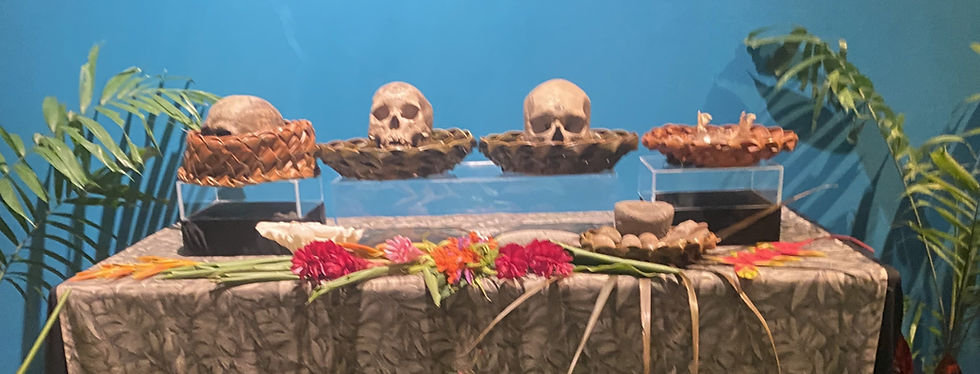
Harvard-led study traces Palau ancestry back nearly 3,000 years


By Ron Rocky Coloma
A new genetic study published in Cell is shedding new light on the origins of Palau’s earliest inhabitants, revealing that the archipelago has experienced one of the longest known stretches of population continuity in Oceania.
The international research team analyzed ancient DNA from human remains found at archaeological sites across Palau and discovered that the islands’ earliest residents already carried a mixture of East Asian and Papuan ancestry. That same genetic pattern has remained largely consistent for nearly 2,800 years.
According to the study, ancient individuals from Palau had about 60 percent ancestry linked to East Asian populations and about 40 percent linked to Papuan populations. The proportions closely match those found in modern-day Palauans, suggesting a remarkable level of continuity between ancient and present-day communities.
Researchers say the findings help clarify how people spread across the Pacific thousands of years ago and challenge some previous theories about when different ancestral groups mixed.
“A natural expectation was that the admixture of Papuan ancestry in Palauan ancestors occurred around the same time as in other Remote Oceanians,” the researchers wrote in the study. “So our new results of earlier Papuan mixture were surprising.”
The study was led by Yue-Chen Liu, Joanne Eakin, Jolie Liston, Rosalind Hunter-Anderson, Ron Pinhasi and David Reich, with researchers from institutions including Harvard University, the University of Vienna, the University of Georgia, the University of New Mexico and the Palau Bureau of Cultural and Historic Preservation.
To investigate Palau’s early population history, the team examined 37 skeletal specimens recovered from four archaeological sites: the Ngkeklau area in northeastern Babeldaob and burial caves at Ngermereues Ridge as well as the Rock Islands of Ucheliungs and Omedokl. From those remains, researchers successfully retrieved genome-wide DNA data for 21 individuals.
Radiocarbon dating shows that some of the individuals lived near the time when people first settled Palau, roughly 3,200 years ago. Two individuals dated between 2,924 and 2,710 years before present and between 2,776 and 2,495 years before present.
Using genetic modeling, the researchers determined that the mixing between East Asian and Papuan ancestral groups occurred well before settlers reached Palau. Their analysis suggests that the two populations began mixing between roughly 3,880 and 3,429 years ago, centuries before the archipelago's earliest known settlement.
That discovery challenges earlier assumptions that Papuan ancestry spread into parts of Remote Oceania only after people had already colonized new islands.
Instead, the findings indicate that the ancestors of Palau’s first settlers were already part of a genetically mixed population before migrating into the region.
The researchers also compared the DNA from ancient Palauans with genetic data from populations across Southeast Asia and the Pacific. Their analysis showed that the East Asian ancestry component of Palau’s early inhabitants is most closely related to populations from eastern Indonesia, particularly the northern Maluku region. Meanwhile, the Papuan ancestry component appears most closely connected to populations from the New Guinea Highlands.
In the study, the term “Papuan” refers broadly to populations whose primary ancestry traces to New Guinea, the Bismarck Archipelago and the Solomon Islands.
Another key finding is that the proportion of Papuan ancestry in Palau has remained relatively stable over thousands of years. Ancient individuals spanning several archaeological periods show similar levels of Papuan ancestry, generally around 40 percent.
That stability contrasts with patterns seen in other parts of the Pacific.
For example, the study notes that Papuan ancestry increased significantly in places such as Vanuatu after later migration waves entered the region. In Palau, however, the proportion of Papuan ancestry remained relatively consistent across individuals dating from roughly 2,900 to 500 years ago.
Researchers say this pattern makes Palau one of the clearest examples of long-term population continuity in the Pacific.
Earlier genetic research has already suggested that the settlement of Micronesia involved several waves of migration. A 2022 study led by some of the same researchers concluded that at least five separate migration streams shaped the region’s populations, including multiple East Asian-related movements, a Papuan migration and later Polynesian influences.
But the new research adds an important piece to that broader picture by showing that the genetic mixing between East Asian and Papuan populations occurred before people reached Palau.
Until now, scientists had little direct genetic evidence from ancient individuals in the archipelago. The lack of genome-wide ancient DNA from Palau left questions about how the islands fit into the broader story of Pacific settlement.
By combining DNA sequencing with archaeological context and radiocarbon dating, the researchers were able to reconstruct a clearer timeline of Palau’s early population history.
Their findings suggest that the ancestors of modern Palauans formed from an early mixture of Asian and Papuan populations and that this genetic heritage remained largely stable for thousands of years after the islands were settled.
For scientists studying the migration of early seafarers across the Pacific, the research highlights Palau’s central role in understanding how people first spread across Oceania.

Subscribe to
our digital
monthly issue