


A practical island solution to an island problem


Majuro—In Micronesia, the debate over the workweek is no longer just about productivity or employee morale. It is now directly tied to our survival costs, fuel imports, electricity prices and the daily realities of island economies that depend heavily on imported energy.
Across the Marshall Islands, the Federated States of Micronesia and Palau, governments and businesses are searching for ways to adapt to rising operational costs. One proposal gaining traction is reducing daily working hours while maintaining a traditional five-day workweek. But in our Micronesian context, a four-day workweek with normal working hours makes far more sense economically, socially and even culturally.
The difference may appear small on paper. One system keeps offices open five days with shorter daily schedules. The other compresses the same total hours into four full working days. But in our island nations, where energy costs are among the highest in the world, the impact is substantial.
The Marshall Islands offers perhaps the clearest example. Our electricity tariffs have climbed sharply in recent weeks, with already high residential rates recently rising from 43 cents to 54 cents per kWh (a 25 percent increase). Government and commercial rates will go from 52 cents kWh to 63 cents (a 21 percent increase).
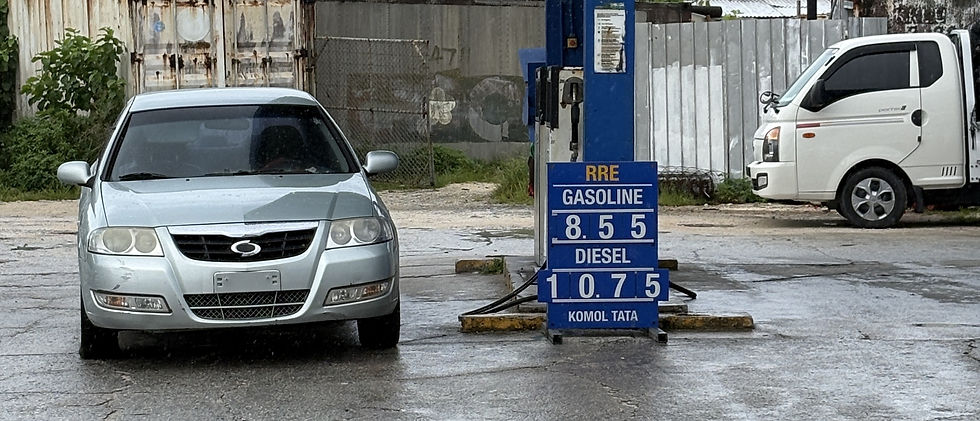
Our fuel prices have also surged dramatically, with gas prices at some stations in Majuro recently moving to over $10 a gallon, while outer island communities continue to experience prices reaching as high as $20 per gallon. For many households already struggling with inflation and stagnant wages, transportation and electricity now consume a major portion of monthly income.
In this environment, keeping offices open an additional day each week carries a real cost. Government buildings, schools and private businesses require lighting, air conditioning, internet systems, refrigeration, computers and transportation. Even if employees work fewer hours each day, an additional operational day still means another day of energy consumption. Air conditioners do not care whether employees work six or eight hours. The building still needs to be powered, cooled and staffed.
A four-day workweek immediately eliminates one full day of operating costs. That means lower fuel consumption for government vehicle fleets, reduced electricity usage in public offices and fewer commuting expenses for workers. In our small island economies, where imported fuel drives nearly every sector, these savings multiply quickly.
For workers themselves, the benefits are even more obvious. In Majuro, Kolonia, Palikir, Ebeye, and Koror, commuting is not insignificant. Fuel costs hit public servants and private employees.
Many families already coordinate rides, borrow fuel money before payday or limit unnecessary travel because of rising prices. Eliminating one commuting day per week effectively reduces transportation expenses by 20 percent. That matters in countries like ours where fuel prices can rise suddenly because of global conflicts or shipping disruptions thousands of miles away.
Micronesia’s geography makes this issue even more unique. Unlike larger countries with interconnected energy grids and domestic oil production, our island nations are almost entirely dependent on imported diesel and fuel. A spike in global oil prices immediately affects local electricity rates and transportation costs. The recent fuel shocks linked to instability in the Middle East demonstrated just how vulnerable our Pacific island economies remain to events beyond our control.
A four-day work week also fits naturally within Micronesian social structures and cultural realities. Family obligations remain central throughout the region. Many people care for extended family members, attend customary events, participate in church activities, or travel between islands and communities for family responsibilities. The additional day off gives workers more time to manage these obligations without sacrificing productivity during the workweek.
This is particularly important in places where informal economic activity still plays a major role in daily life. In many outer island and rural communities across the FSM and the Marshall Islands, people continue to engage in subsistence fishing, farming, food preparation, handicrafts and community labor. An extra day allows them to contribute to family and community needs without constantly balancing those responsibilities against rigid five-day schedules imported from outside systems.
The Pacific has always adapted external systems to local realities. The standard Western workweek was never designed for scattered island nations facing extreme transportation costs, fragile supply chains and limited energy infrastructure. There is no reason Micronesia should continue forcing itself into models designed for industrial economies with entirely different circumstances.
Critics sometimes argue that a compressed four-day work schedule could create fatigue or reduce public access to services. But these concerns are manageable. Governments and businesses can stagger schedules for essential services, maintain emergency staffing and use technology for remote accessibility. In reality, many offices already lose significant productivity due to inconsistent daily attendance, which is often caused by transportation difficulties, family obligations or weather.
There is also evidence globally that compressed work schedules often improve employee morale and efficiency. Workers tend to become more focused when time is structured more efficiently. But in Micronesia, the strongest argument is not based on international productivity studies. It is based on simple economics.
Every extra day an office operates carries direct costs in fuel, electricity, maintenance, transportation and infrastructure strain.
In island nations where electricity can cost more than three or four times the average American rate, reducing operational days is one of the few immediate cost-saving measures available without cutting salaries or laying off workers.
There are environmental benefits as well. The Marshall Islands, Palau and the FSM are among the countries most vulnerable to climate change and sea level rise, yet we remain heavily dependent on imported fossil fuels. Reducing weekly fuel consumption, even modestly, aligns with broader regional goals of lowering emissions and transitioning toward renewable energy.
The Marshall Islands has already emphasized that our future depends on reducing diesel dependence and improving energy efficiency. A four-day workweek supports that direction immediately, without requiring massive investments in our infrastructure.
ADVERTISEMENT

Perhaps most importantly, the four-day workweek recognizes the economic reality facing ordinary Micronesians. Governments often ask citizens to adapt during difficult economic times, but our people are already adapting every day. Families are absorbing rising utility bills, increasing food prices and escalating transportation costs. A compressed workweek offers a practical response that provides measurable relief without reducing wages or services.
Micronesia cannot control global oil prices. We cannot stop international conflicts from disrupting shipping routes or increasing fuel costs. But we can make smarter decisions about how our own economies operate. A four-day workweek is not a radical experiment in our region. It is a practical island solution to an island problem.
Jack Niedenthal is the former secretary of Health Services for the Marshall Islands, where he has lived and worked for 45 years. He is the author of “For the Good of Mankind, An Oral History of the People of Bikini” and president of Microwave Films, which has produced six award-winning feature films in the Marshallese language. Send feedback to jackniedenthal@gmail.com

Subscribe to
our digital
monthly issue


