


US proposes first deep-sea mining leases for American Samoa's seafloor


By Mar-Vic Cagurangan
The Bureau of Ocean Energy Management today issued a notice advancing the lease of American Samoa’s seafloor for mineral extraction, forging ahead with the Trump administration’s bid to launch America’s deep-sea mining industry.
The bureau plans to lease two large areas for 20 years, with each requiring a minimum bid of $3 million, for the development of all minerals found in polymetallic nodules and ferromanganese crust deposits within the designated areas. Escalating royalties would start at $1.25 per acre and increase over time.
The initial auction is currently scheduled for Nov. 19.
“Advancing this notice is an important step toward building a secure domestic critical minerals supply chain, strengthening U.S. economic and national security and ensuring America can compete and win in the 21st century,” said Matt Giacona, acting director of the Marine Minerals Administration.
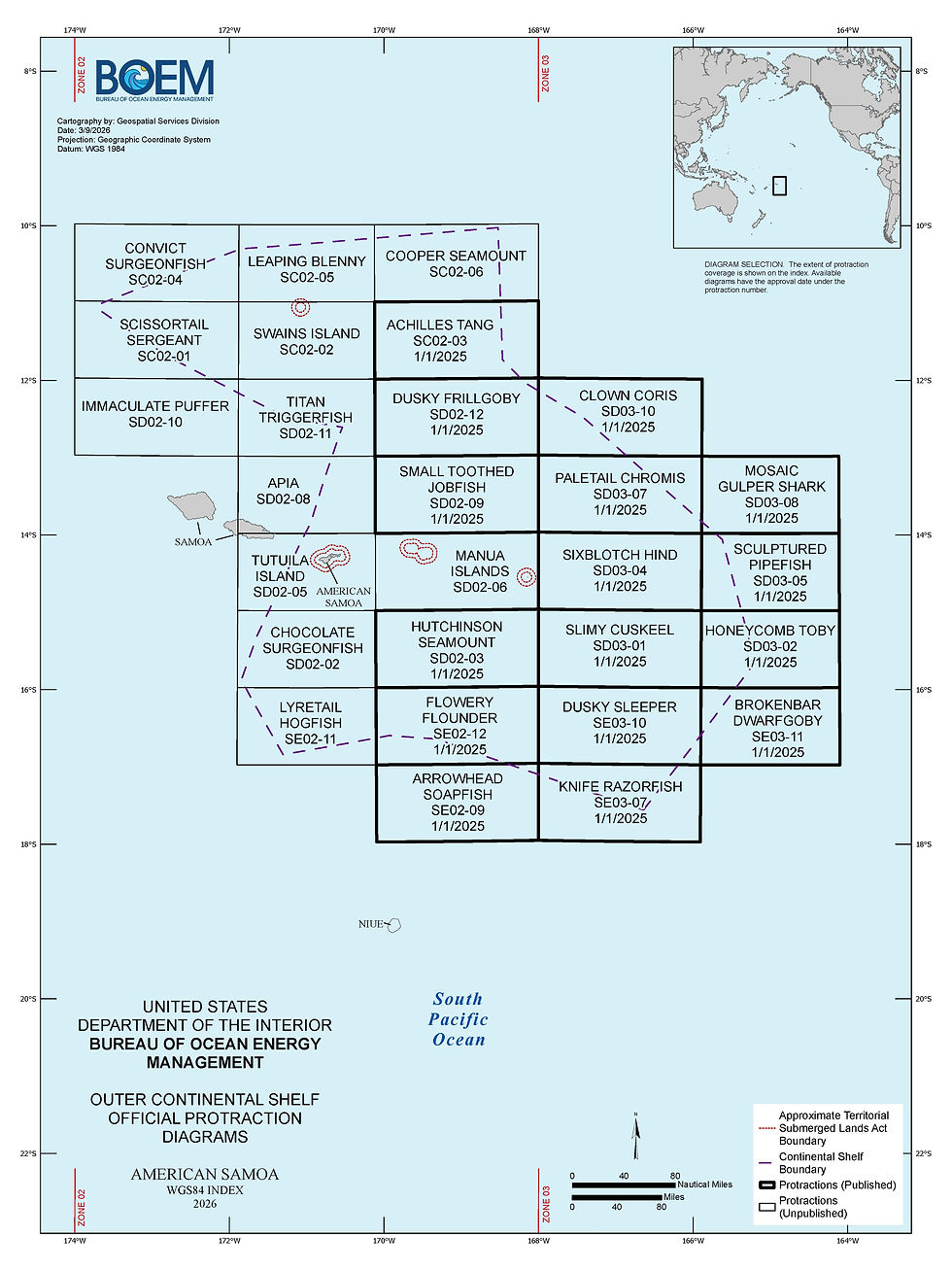
The bureau has marked 33 million acres of seabed near the eastern edge
of American Samoa’s exclusive economic zone for the mining of polymetallic nodules, which are critical to the production of clean energy and military technologies.
“Critical minerals have become a strategic asset in global competition and China’s dominance in the supply of many of these materials creates unacceptable risks for America’s energy, defense and manufacturing sectors,” Giacona said.
The proposed leasing notice provides information on sale terms and conditions, such as hiring American Samoans, partnerships with local businesses and using the port of Pago Pago for operations.
“Once the notice of availability is published, MMA can move forward with the remaining pre-sale requirements, including publishing a final leasing notice in the Federal Register at least 30 days prior to the sale date, should MMA decide to hold a sale,” the bureau said.
The governor of American Samoa has 60 days to review and comment on the proposed leasing notice before the bureau issues a final leasing notice.
“American Samoa has existing handling, shipping and industrial know-how to expedite all three streams, environmentally safe mineral extraction, non-toxic refining and end-user manufacturing specifications to become America’s go-to-critical mineral reliable source for the economic and irregular global warfare battle in the newest iteration of America’s national defense,” according to John Wasko, executive director of American Samoa Development Council.
The National Oceanic and Atmospheric Administration’s subsea surveys have determined that American Samoa and neighboring Cook Islands have sufficient resources to supply America’s dual-purpose military and commercial demand for energy minerals, cobalt, manganese, copper and nickel for the next 50 years.
Wasko said American Samoa is logistically positioned on the front lines of America’s economic and irregular warfare battle as a safe, secure and reliable source of military- and commercial-grade refined critical minerals.
“Auto manufacturers and defense contractors mainly are already actively seeking safe, secure and reliable end-user critical mineral resources in American Samoa,” he said.

The federal government is pushing on with deep-sea mining despite opposition from the American Samoan government and environmental activists.
“This proposal is out of step with what communities actually want. Opposition to offshore mineral extraction is not limited to American Samoa or the Mariana Islands," said Angelo Villagomez of the Center for American Progress in Washington, D.C.
He argued that the waters around American Samoa support unique ecosystems, cultural traditions and livelihoods that cannot be replaced once damaged.
"BOEM should be listening to the Pacific communities that have consistently spoken out against extractive activities in our ocean, rather than advancing a lease sale that lacks broad public support," Villagomez said, noting that the bureau's request for information issued last year drew 70,000 public comments opposing the plan.
ADVERTISEMENT

Sabrina Suluai-Mahuka, founder of American Samoa's nonprofit Finafinau, protested the lease sale, noting the ocean's cultural value to the island's residents.
"Our home is not for sale," Suluai-Mahuka said. “The moana is our first teacher, our source of life, and our greatest inheritance. We don't measure its worth by the minerals beneath it. We measure it by the families it feeds, the cultures it sustains, and the children it will one day nourish."
Maria Hernandez, of Micronesia Climate Change Alliance on Guam, criticized federal decisions affecting local resources.
"We refuse to be treated as a box to check instead of partners in decisions that affect our livelihoods and the future of our children. The people of the Marianas stand with American Samoa. Hands off our sacred seabed," she said.
Sheila Babauta, chair of the Friends of the Mariana Trench, called on "people around the country" to join Pacific Islanders in opposing federal plans to raid the seafloor of the Pacific Ocean.
“We stand with the communities of American Samoa who are calling for stewardship and self-determination, and we reject unilateral federal actions that threaten the health of our ocean and the rights of the people who depend on it," said Adi Martinez Roman, a Puerto Rican member of the Right to Democracy.

Subscribe to
our digital
monthly issue


