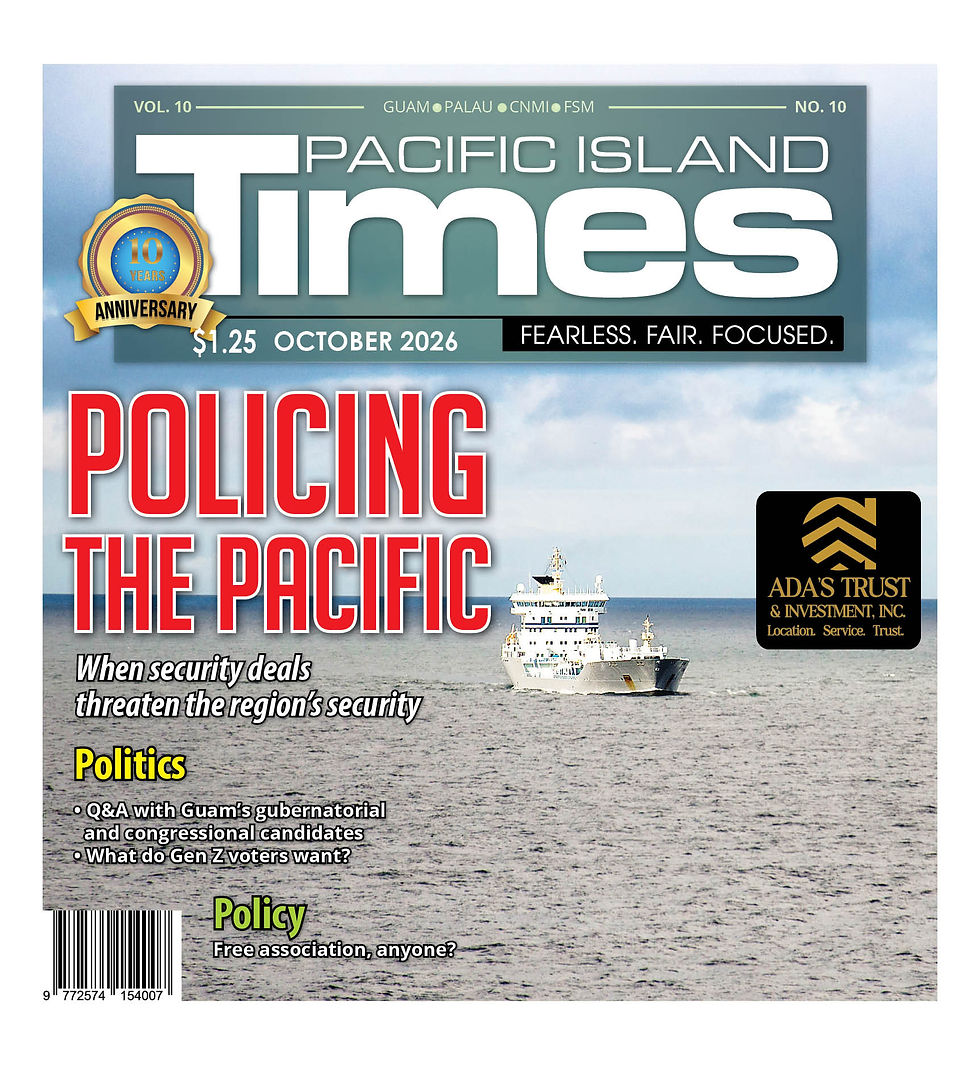
US launches initiatives to police the Pacific against drug cartels


By Mar-Vic Cagurangan
Expanding its anti-drug trafficking campaign, Washington has officially launched the Pacific police program and designated Palau as the hub for training and operations to build border protection against narcoterrorism in the region.
“The networks threatening Pacific communities operate as a single criminal enterprise,” the U.S. State Department said, announcing more than $44 million in new programming to counter drug cartels operating in the region.
U.S. officials said that since 2024, the narcotics that South American and Southeast Asian drug rings traffic through the Pacific have surpassed the flow from Asia.
Illegal drugs manufactured in clandestine labs in Mexico, Colombia, Ecuador and Southeast Asia move across the Pacific by courier, international mail, private aircraft and semi-submersible vessels, officials said.
“Each link in this chain depends on the others. Breaking the enterprise requires action at every link, starting where drugs and precursors first enter legitimate trade,” the State Department said. “All of this is supported by extensive money laundering operations.”
The State Department hosted the inaugural U.S.-Pacific Islands Conference of Police Ministers in Los Angeles from Oct. 21 to 22, following through with its announcement during the Pacific Islands Forum’s leadership meeting in Palau on Sept. 1.
Senior police officials from the Pacific Islands, Australia, New Zealand, France, and Southeast Asia joined the summit.
The fresh round of U.S. investments will cover police and investigative training, supplemental resources and new infrastructure to beef up the island states' border security and interdiction capabilities.
“Working with Interpol, this effort will complement existing regional information sharing efforts by connecting police services in its network of 196 member countries, linking seizures to investigations and to the money behind them,” the State Department said.
Drug trafficking is one of the most critical security issues facing the Pacific islands region, which has earned a reputation as the new “narco highway,” where methamphetamine, heroin and cocaine have streamed into the islands.
Earlier this year, Fiji declared its drug crisis a national emergency.
ADVERTISEMENT

Drug cartels thrive in the region due to its weak law enforcement mechanisms and limited resources to patrol the vast exclusive economic zones. Most island states rely on maritime partnerships with the United States, Australia and New Zealand.
According to the Center for Strategic and International Studies, the illicit drug trade across Asia-Pacific was estimated to be worth between $30.3 billion and $61.4 billion as of 2019. From January to July alone, maritime authorities intercepted 10 drug-ferrying ships in the Marshall Islands, Fiji, the Cook Islands and French Polynesia.
Washington said the new round of U.S. investments in the Pacific region is aimed at “stopping narcotics before they reach our shores” by cracking down on drug cartels.
“The World Customs Organization will draw on its 187 member customs administrations to train Pacific officers in the channels traffickers exploit most, including general aviation, international mail and detector-dog operations and will feed intelligence from border controls to investigators,” the State Department said.
ADVERTISEMENT

The U.S. will build a $7 million regional maritime law enforcement training and coordination center in Palau, which will serve as the headquarters for the Aumoana Regional Law Enforcement Initiative.
The center will also be home to U.S. and regional liaison officers who provide intelligence support across the Pacific islands and U.S. territories.
Two U.S. Customs and Border Protection officers will be embedded in Palau for a 60-day advise-and-assist pilot.
The U.S. is providing more than $1.3 million to train investigators in Fiji, Tonga, the Marshall Islands, the Federated States of Micronesia and Palau in narcotics investigations, financial investigative techniques and maritime operations planning.
The Pacific Islands Forum Fisheries Agency, Fiji’s maritime services and the Pacific Transnational Crime Coordination Center in Samoa are receiving $1.4 million in maritime surveillance tools.
ADVERTISEMENT

The U.S. will fund the construction of a boat ramp in Fiji to improve the nation's interdiction of illicit drugs and cargo.
The Papua New Guinea National Fisheries Authority will receive four patrol boats equipped with advanced electro-optical and infrared cameras, upgraded radar displays and real-time data transmission.
In Tonga, the U.S. will install technologically advanced cargo-screening equipment at Queen Salote International Wharf in Nuku’alofa.
The U.S. Coast Guard will expand bilateral Shiprider operations with Pacific partners. Under these arrangements, Pacific law enforcement officers serve aboard U.S. Coast Guard cutters with authority to enforce their own nations’ laws throughout their exclusive economic zones. This extends enforcement across waters that no single nation can patrol alone.
Subscribe to
our digital
monthly issue