


Trade over aid: US promotes commercial diplomacy in the Pacific


By Mar-Vic Cagurangan
Washington is stepping up its engagement in the Pacific with a new support strategy that prioritizes private-sector development over direct aid, according to a federal official.
Matt Murray, the State Department’s deputy assistant secretary for Australia, New Zealand and the Pacific Islands, said the U.S. is expanding commercial diplomacy to promote trade rather than aid.

“We therefore are reorienting our foreign assistance programs to support private sector-led growth in the Pacific,” Murray said in a virtual press conference on Tuesday.
The new foreign aid policy is aligned with President Donald J. Trump’s Jan. 20, 2025 executive order, which pauses development and humanitarian assistance, affecting 83 percent of the programs administered by the U.S. Agency for International Development.
In February, the State Department and the Pacific Command co-hosted the inaugural U.S.-Pacific Islands Trade and Investment Summit at the East-West Center in Honolulu, where over 80 American companies converged to meet with Pacific island leaders to discuss partnerships and business opportunities with the U.S. private sector.
Murray said digital connectivity is one area where the U.S. seeks to assist the island nations with economic development.
“A great example of this approach is our work with the private sector and with Australia, Japan, New Zealand and Taiwan to collectively ensure every single Pacific Island Forum country is connected to a trusted undersea cable network,” he said.
The U.S., Australia and Japan jointly funded the $95 million East Micronesia Cable that now connects the Federated States of Micronesia, Kiribati and Nauru.
“Another is our reaffirmed commitment to the South Pacific Tuna Treaty, which for nearly four decades has supported jobs and livelihoods for Americans and Pacific Islanders,” Murray said.
Last year, the United States announced $60 million in assistance to the Pacific Islands Forum Fisheries Agency associated with the South Pacific Tuna Treaty, which allows U.S.-flagged vessels to fish in the exclusive economic zones of 16 Pacific island countries. The State Department said this investment is generating hundreds of millions of dollars per year in gross revenue for the U.S. economy.
“We’re not simply engaging the Pacific because of a desire just to deter or oppose China, but really because we want to, as the United States, have better relationships with these countries, which are so important to our own security and our own prosperity at home,” Murray said.
Unwittingly dragged into the geopolitical battle for influence, the Pacific island nations form the world's most aid-dependent region. China’s Belt and Road Initiative has launched more than 30 projects in island nations since 2013, paving the way for Beijing to expand its clout and sparking great-power games in the region.
According to the Lowy Institute, the Pacific islands received $3 billion in 2022, supporting the region’s development. At the same time, however, it also poses strategic vulnerabilities.
Australia is the largest contributor among 80 foreign donors, Lowy Institute said.
ADVERTISEMENT

At the 55th Pacific Islands Forum Leadership Meeting in Palau, Deputy State Secretary Christopher Landau unveiled a $150 million investment in the Pacific.
“This financial support will serve to ensure energy security, build critical infrastructure, expand commercial diplomacy, promote trusted digital technology, advance law enforcement cooperation and maritime security, deepen scientific and technical cooperation, and expand people-to-people ties,” Murray said.
He said Washington sought to respond to a strong demand signal from Forum's member countries affected by fuel-related impacts of the Iran conflict.
“The deputy secretary, therefore, was pleased to announce at the PIF that working with Congress, the department intends to provide $60 million to help Pacific island countries address both short-term budgetary shortfalls in the wake of the ongoing global energy crisis as well as longer-term needs such as expanding fuel storage capacity and supporting grid stability,” Murray said.
ADVERTISEMENT

In Tonga, the U.S. Trade and Development Agency plans to strengthen Tonga’s fuel supply reliability and energy security through a feasibility study to help upgrade Tonga’s port facilities, fuel storage capacity, pipeline infrastructure, and market-oriented regulatory practices.
Since the investment summit in February, Murray said key negotiations have moved forward with U.S. geothermal companies in Vanuatu and Tonga and there has been a major satellite internet connectivity announcement in Papua New Guinea.
Landau will host a second Pacific Investment Summit in early 2027 “to continue advancing commercial cooperation,” Murray said.
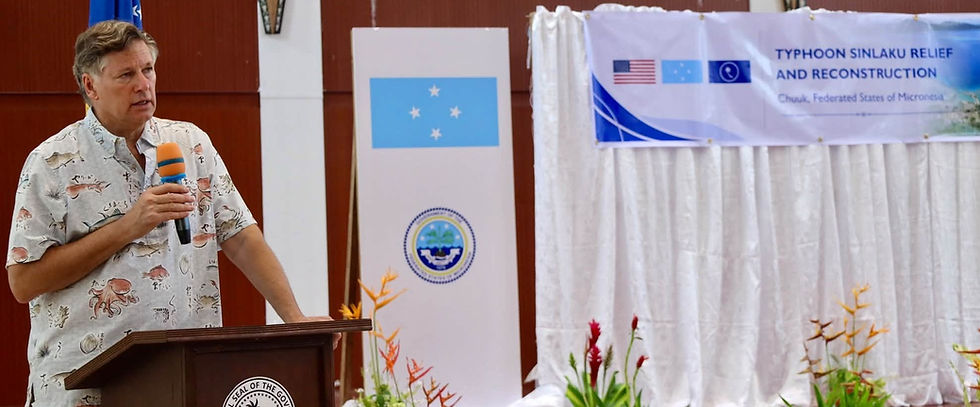
Landau's 12-day Pacific tour also covered the Federated States of Micronesia, the Solomon Islands and Kiribati.

Subscribe to
our digital
monthly issue


