


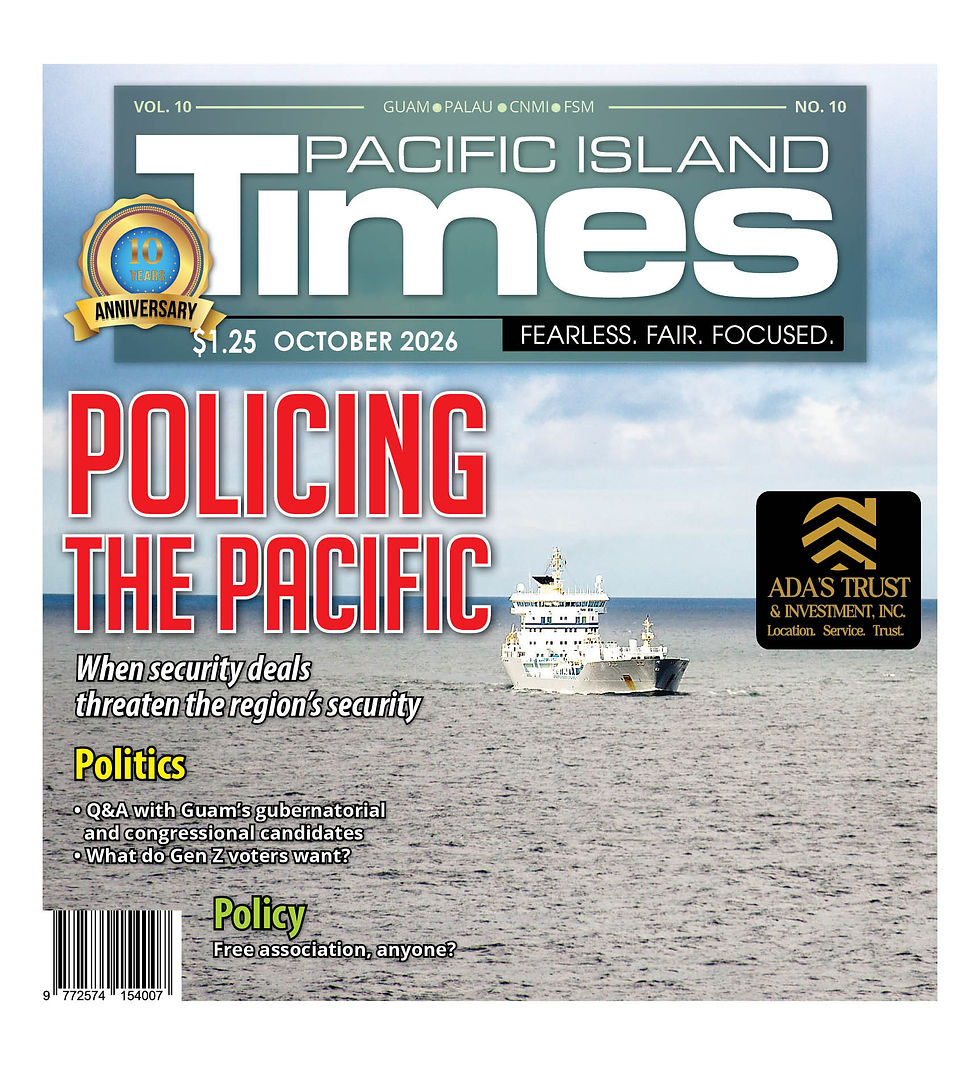
Pushing a reluctant discourse on free association option for Guam


By Jayvee Vallejera and Mar-Vic Cagurangan
Free association represents the “best of both worlds,” according to a long-forgotten essay published in Guampedia. “With free association, Guam would be recognized internationally as a sovereign nation with control over its political affairs,” reads the article authored by the Free Association Task Force. “At the same time, we would also maintain a defined association with the United States, specifically in the area of defense.”
Free association is one of the three political status options proposed for Guam, along with statehood and independence. In the Guam legislature, Sen. William Parkinson spearheads the campaign for statehood. He calls for Guam’s full integration as the 51st state of the United States. CHamoru activists push for Guam’s independence, with its own sovereign government that has a place on the world stage, handling its own foreign affairs.
The free association option, however, is an orphaned movement. With no vocal advocates, free association receives scant attention and generates little discussion.
The Guam Decolonization Commission’s Free Association Task Force was dormant for many years until its reactivation in 2024. The task force reemerged last month when it hosted the “Hita La'mon: Toward Sovereign Futures,” a self-determination forum designed to envision a sovereign Guam.
While designated to advocate for free association, the task force focuses on sovereignty as a broader concept, according to its chair, Nolan Flores.
“We're not really saying free association is the best option. We're not saying that it should be the only option we should pursue,” said Flores, who took the task force’s helm in 2024. “Rather, we want to take a critical and transparent look at free association as a viable status. The real key is sovereignty, and each of the statuses provides a level of sovereignty.”
The United States’ Compacts of Free Association with Palau, the Marshall Islands and the Federated States provide a template for Guam. New Zealand has similar arrangements with the Cook Islands and Niue.
“You're a sovereign state and you enter into a mutually negotiated relationship with the United States,” Flores said. “When we say free association is viable, we have the freely associated states that we can look to.”
In 2018, Robert Riley III, then U.S. ambassador to the FSM, said that the compacts were the result of a unique and unrepeatable event in U.S. history. He issued the video message in response to Chuuk’s attempt to break away from the FSM and establish an independent state, with plans to negotiate with the U.S. for a similar free association status.
“That's non-negotiable. In order for there to be another compact with Chuuk, there would have to be a separate compact negotiated. That will not happen. There is no possibility for a separate Compact with Chuuk,” Riley said in the video message.
When asked if his 2018 statement still stands today, Riley, who retired from foreign service six years ago, replied: “It seems unlikely that the policy would have changed since early 2020.”
Robert A. Underwood, former president of the University of Guam, said Riley’s statement specifically applies to the FSM and does not necessarily foreclose the free association option for Guam.
“It doesn't mean that Guam or American Samoa or the Northern Mariana Islands or even Puerto Rico can’t say, ‘Let's entertain a Compact of Free Association.’ It doesn't mean that that can't happen,” Underwood said.
He said Riley’s remarks addressed the political reality of the existing FSM compact: a state leaving that arrangement could not assume that Washington would negotiate a duplicate agreement.
Underwood, who served as the territory's delegate to Congress for 10 years, made a case for free association, describing it as a path to full sovereignty that would allow Guam to negotiate with the federal government over decisions affecting the island. “The upside is you get to exercise sovereignty. You get to be a participant in what the U.S. government is doing in your country,” he said.
Underwood said the federal government’s aggressive push for seabed mining and the military buildup in the region highlight Guam’s powerlessness as an unincorporated territory. The lack of political power often goes unnoticed until a federal action exposes it, he said.
Conversations about free association are stymied in part by concerns about passport displacement. “People are afraid that, under the Compact of Free Association, they would lose their U.S. citizenship,” Underwood said. “But the U.S. government—try as they can—can't take away your citizenship.”
Independence is widely discussed because its advocates have a fairly robust outreach initiative and vocal presence, Flores noted.
Statehood is equally familiar to Guamanians. “People see statehood as, maybe, the easiest option in a sense because they see our proximity to the U.S. and that being a territory, we have some aspects that a state does,” Flores said.
ADVERTISEMENT

Guam cannot vote in the presidential election, and its lone delegate to Congress has no voting power on the House floor. Some provisions of the U.S. Constitution don’t apply to Guam.
While Guam lacks critical representation in the federal government, Flores noted that the local governance structure mirrors that of a state. “So, there's a familiarity to statehood,” he added.
Some, however, are content with the status quo, which grants Guam federal tax and tariff waivers.
Flores said free association would position Guam in the middle ground as an independent state in a close relationship with the U.S. Quoting the old Guampedia article, Flores said, “it represents the best of both worlds.”
But before discussing the merits of each proposed option, Flores said Guam must first envision its landscape as a decolonized territory.
“We haven't been viewing our potential futures with the lens of sovereignty,” he said. “So we've just restarted the task force and started doing outreach to create a buzz around the status.”
Subscribe to
our digital
monthy issue

