


Plans, priorities and promises: Q&A with Guam's gubernatorial teams


By Ron Rocky Coloma
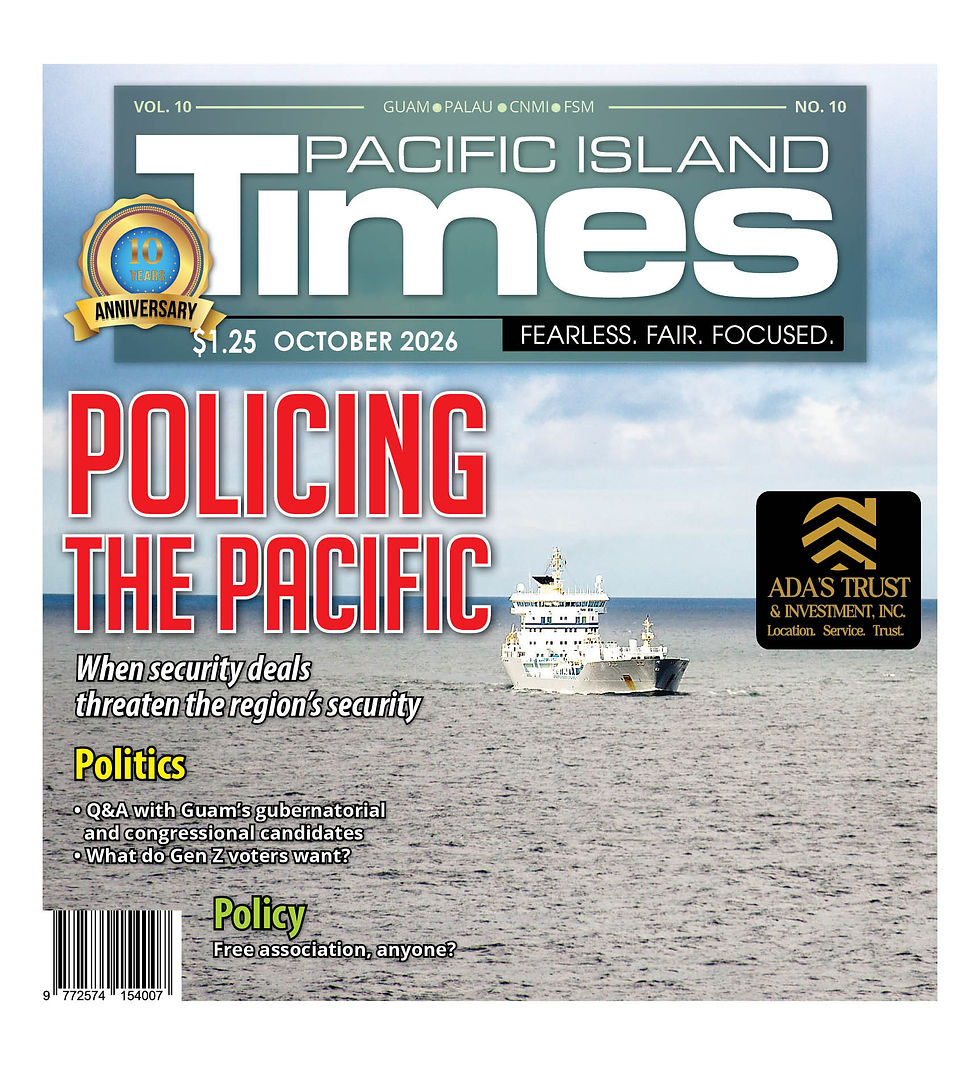
Guam voters will head to the polls on Nov. 3 amid buzz about fresh leadership. The gubernatorial race is being contested between the Democratic team of Therese Terlaje and Sabina Perez and the Republican ticket of Tony Ada and Edward Calvo.
The Pacific Island Times asked both teams about their plans, priorities and how they would address issues facing the island if elected.
Here are their responses: (First of a two-part series)
Guam's economy is increasingly shaped by billions of dollars in U.S. defense spending, while residents and local businesses also face pressure on housing, infrastructure, utilities, land, labor and the cost of living. If elected, how would you ensure the military buildup produces lasting economic benefits for Guam residents rather than an economy increasingly dependent on federal defense spending? What specific commitments would you seek from the federal government and where would you draw the line if federal priorities conflict with Guam's local needs?
Terlaje-Perez: First, the federal government has pledged and must continue to contribute to the civilian infrastructure that its presence depends on and places additional pressure on, including sewer and water systems, roads, power, healthcare, and housing. We will advocate for better projections of military demand, full use of appropriate on-base housing and federal assistance to expand off-base housing and the infrastructure needed to support it, including pivoting of the existing H2B visa workforce.
Second, more of the economic activity must remain on Guam. We would advocate for full receipt of applicable taxes, federal contracts that local businesses can realistically compete for, along with apprenticeships and training that prepare residents for careers beyond the construction buildup. That includes the building trades and emerging fields such as cybersecurity or additive manufacturing.
Third, Guam must properly manage and fully utilize federal funds, complete projects and account for every dollar. Our administration will strengthen procurement, compliance and transparency so Guam does not lose opportunities because of poor execution.
The Terlaje-Perez administration will prioritize a healthy and safe environment for military and local residents, and that mitigation required to address adverse impacts from military projects are complied with to prevent contamination of our drinking water, impacts to ancestral lands, cultural resources and housing costs.
Ada-Calvo: The Ada-Calvo administration will aggressively pursue opportunities for Guam businesses and workers to participate in federal spending. We will work with local contractors, suppliers, professional services, transportation companies and small businesses to remove barriers to federal work, while strengthening workforce pipelines through GCC, UOG, our schools and apprenticeship programs.
Our federal agenda will seek support for roads, utilities, water, wastewater, healthcare, public safety and housing infrastructure; continued access to the workforce needed for civilian and defense construction; and recognition of the extraordinary burdens federal growth can place on a small island community.
We will be a strong, capable and constructive partner with the military and federal government. Partnership should produce shared results: stronger infrastructure, greater local business participation, a skilled workforce and better-paying careers.
We strongly support America's national security mission and Guam's role in the Indo-Pacific. But partnership must work both ways. If federal actions impose unreasonable costs on our people, threaten critical local resources, or undermine Guam's ability to meet local needs, we will speak up and negotiate aggressively for Guam.

                             The Candidates
Therese M. Terlaje: A five-term senator and former speaker of the Guam Legislature. An attorney by profession, she practiced in the fields of corporate law, juvenile law, family law, and real estate. She taught criminal justice and public administration at the University of Guam.

Sabina Perez: A four-term senator. She is a former diabetes researcher at the University of California and a former teacher at Simon Sanchez High School. She earned a Bachelor of Science degree in Medical Technology from the University of Washington.
Vicente Antonio Ada: A six-term senator. He served in the U.S. Army and Army Reserve from 1986 to 1993. After military service, he entered the private sector, working as an aircraft mechanic and later as vice president of Ada’s Mortuary Inc. He previously served as director of the Department of Youth Affairs.

Edward John “EJ” Calvo: An entrepreneur and business executive who previously chaired the Guam Economic Development Authority board and serves as head coach of Guam's men's national basketball team. He has led companies including Island Beverage Distributors, Island Wines & Spirits and Tropical Productions Inc.
ADVERTISEMENT

For decades, Guam leaders have discussed diversifying the economy beyond tourism and federal spending, yet those two sectors remain dominant. Name two industries outside tourism and defense-related construction that your administration would realistically develop. What specific policies, infrastructure, workforce investments or regulatory changes would you pursue to make those industries viable, and what measurable results should voters expect by the end of four years?
Ada-Calvo: Three diversification priorities are regional health care; trade, logistics and local production anchored by Port modernization; and technology and digital services.
Health care can become both a stronger service and a larger part of our economy. We will expand workforce pipelines through UOG and GCC, improve recruitment and retention, pursue licensing reforms and regional partnerships and work with public and private providers to expand specialties. Our goal is to keep more healthcare dollars on island, create professional careers and strengthen Guam as a health care center for the Western Pacific.
Our second opportunity begins at the port. Modernizing operations, expanding cold storage capacity, improving cargo efficiency and reducing logistical bottlenecks can lower the cost of moving goods while supporting agriculture, fisheries, food production, warehousing, distribution, recycling, light manufacturing, transshipment and regional trade. More efficient movement of goods and greater local production can help address the cost of living while keeping more dollars in Guam's economy.

Third, we will pursue technology and digital services by leveraging Guam's telecommunications infrastructure and expanding training in cybersecurity, network administration and other high-demand fields. We will support entrepreneurs and technology ventures by providing access to capital and fostering a more efficient business environment.
We will streamline permitting and licensing and align workforce development with industry needs.
By the end of four years, voters should see expanded healthcare employment and capacity, increased local production and logistics investment, improved Port efficiency and measurable growth in locally rooted technology businesses and high-skilled jobs.

Terlaje-Perez: Two of the industries the Terlaje-Perez administration would focus on are housing and agriculture/aquaculture. Both can create skilled local jobs, develop products for Guam, and generate exports.
We need a huge expansion in housing construction and repurposing of old buildings with existing infrastructure. This would require workforce expansion, including H2B visa workforce and investment in training and job paths for hundreds of local students.
This will also be prioritized through QC programs, infrastructure investment, pre-approved zoning and design, use of government land, Guam’s unique duty-free status and additive materials manufacturing.
For agriculture/aquaculture, the Department of Agriculture, in collaboration with the Farmer’s Cooperative, Soil and Water Conservation Districts, UOG Cooperative Extension, and other entities, will organize farm/aquaculture production to promote diverse and sustainable crop production and support the development of value-added or niche products.

We will support farmers through buy-local programs and help fund farming infrastructure to increase resiliency to typhoons, flooding, and other disasters.
By the end of four years, voters should see residents trained and hired in construction trades, local companies building affordable housing and capital improvement projects, and a sustainable agriculture industry supporting local needs and producing products for export. We will judge diversification by the businesses created, the permanent jobs produced and the new income retained on Guam.
Guam's relationship with the United States brings substantial federal funding and national security investment, but territorial status also limits the island's political representation and control over decisions involving immigration, land, defense and other federal policies. What specific changes in the Guam-U.S. relationship would you pursue during your term, and how would you give Guam a stronger voice when federal decisions directly affect the island?

Terlaje-Perez: The Terlaje-Perez administration will work toward a Guam-U.S. relationship built on mutual respect and cooperation, and true protection of our health, land, drinking water, cultural resources and environment.
Guam should leverage its strategic importance for true consultation and proactive discussion at the table before federal decisions are made that may impact the people of Guam, and not after those decisions are already final, such as what is happening with leases for deep-sea mining.
Our administration will work closely with our delegate to Congress and also establish direct, regular communication with Congress, the Department of the Interior, the Department of Defense, other federal agencies, task forces and commissions to avoid harm and to maximize benefit to Guam in any federal undertaking. We will advocate for more reasonable comment periods for more effective input and coordinate local agency responses for public view. Data evidencing Guam’s needs and priorities and historic injustices must be kept and utilized in discussions and negotiations.

Federal commitments should be documented and publicly tracked for our people to know what was promised and what was delivered, including mitigation for the predicted and documented adverse environmental and socio-economic impacts to housing, roads, utilities, healthcare and other public services. Our administration will also insist that Guam residents and businesses receive fair access to jobs and contracts.
Ada-Calvo: The Ada-Calvo administration will pursue a more assertive and organized federal strategy. Rather than waiting until policies are finalized in Washington, we will engage Congress, the White House and federal agencies early on infrastructure, labor, transportation, healthcare, veterans, defense, immigration and economic policy.
We will advocate for greater federal parity where Guam residents are treated differently simply because we live in a territory. We will also make clear that federal policy cannot always take a one-size-fits-all approach. Guam's geography, economy, culture and strategic responsibilities require federal policymakers to understand the practical consequences of decisions made in Washington.
We will strengthen relationships with governors and congressional leaders throughout the territories and Pacific region where our interests align. Guam is more effective when we build coalitions around common interests.
Most importantly, federal engagement cannot consist solely of letters sent after decisions have been made. The Ada-Calvo administration will personally build relationships with federal decision-makers, invite them to Guam, bring Guam's case directly to Washington and push for meaningful consultation when federal decisions affect our island.
The strongest federal policies affecting Guam are those developed with Guam, not simply for Guam. We will build strong, professional and mutually beneficial federal relationships while never hesitating to advocate for Guam's interests.
Subscribe to
our digital
monthly issue


