


Palau's balancing act amid its growing leadership role in the region


By Alex J. Rhowuniong
On the map, Palau may appear like just a collection of isles in a vast blue ocean. But maps don’t always depict the real picture. Palau is a sovereign country, a nation of people defined by a rich culture, traditional values and strong relationships.
Approximately 17,600 people live in this island nation. Its fragile $347 million economy is dependent on tourism.
Palau may be small—very small—but as it marks its 32nd Independence Day this month, Palau’s reputation looms large in the global landscape. In September, Palau hosted the 55th Pacific Islands Forum Leaders Meeting, drawing hundreds of delegates from neighboring island nations and territories.
“(Our parents and grandparents) have shown us and continue to inspire us on what we must do to keep our relationship strong,” Palau President Surangel Whipps Jr. said.
He is often seen fishing with his wife, Valerie Whipps, and posing with his catch on social media. “We may have challenges; however, if we put God in the center of our home, we can weather life’s challenges,” Whipps said.
As Palau’s president, Whipps navigates the challenges of geopolitics. He stands up to China, resists the communist regime’s pressure and maintains Palau’s strong ties with Taiwan.
Palau is freely associated with the United States under the Compact of Free Association, which establishes their security agreements.
But through a Micronesian lens, something deeper is happening. This is not simply about the rivalry between Washington and Beijing. It is about something much more basic: Who gets to decide what happens in your own home?

In his opening remarks at the Forum meeting in Koror on Sept. 1, Whipps drew the line at partnerships with nations with strategic interests in the region.
“Our partners are welcome to sail with us,” said Whipps, who chairs the Forum.
“But they do not choose our destination. The Pacific agenda must be driven by us, for us, and the forum must remain the political home in which that agenda is shaped.” For large countries, sovereignty is often discussed in terms of military capability, economic strength and geopolitical influence.
For an island nation, sovereignty is much more personal. It means deciding who enters your waters, determining how your land and resources are used, choosing your diplomatic relationships and ultimately having the ability to say: “This is our home. We have a right to decide its future.”
That is what makes Palau's relationship with Taiwan significant. Palau is one of the three remaining Pacific countries diplomatically tied to Taiwan.
Despite China’s decision to blacklist Palau as a travel destination for its citizens, Whipps remains unfazed. He has continued to defend Palau’s relationship with Taiwan amid diplomatic and economic pressures that accompany such a position.
Viewed from outside the Pacific, that may look like another move on a geopolitical chessboard. Viewed from the islands, it means something much simpler: the right to choose. That distinction matters throughout Micronesia.
The Pacific is increasingly an arena where major powers compete for strategic access, diplomatic influence, economic relationships and security partnerships.
The United States has longstanding relationships with Micronesian nations. China has expanded its presence across the region, while Australia, Japan, New Zealand and others maintain their own regional interests.
Island nations sit in the middle of all this—courted, supported and sometimes pressured. At times, they are treated as though their greatest importance is their geography. Palau knows this reality. Its location gives it strategic significance far beyond its size.
ADVERTISEMENT

Its waters, airspace and tourism industry matter. But to the people who live there, Palau is not a strategic location; it is home.
Whipps attributes his tenacity to his father.
“My father, Rekemesik Surangel Whipps, was a man of iron will and immense heart. He was strict, but that discipline was the scaffolding he built so we could grow straight and true. He pushed us to be our best because he saw something in us long before we ever saw it in ourselves.”
“Whether he was teaching us to swim in strong currents or fish in the deep, he was really teaching us how to navigate life: with courage, resilience and faith,” Whipps added. The ocean surrounding Palau is not simply blue space on a military map. It is where people fish, travel, work and live. It carries culture, history and generations of knowledge.
“(My father) was the kindest, most humble and hardworking person I have ever known. He reminded us often that this life is temporary—we are only passing through,” he said.
Before entering national politics, Whipps worked in the private sector, helping lead his family business, Surangel & Sons Company. He later served in the Palau Senate before winning the presidency in 2020 and securing a second term in 2024. An islander understands something a distant geopolitical analyst can easily forget: the ocean does not merely separate the islands—it connects them.
ADVERTISEMENT

“Our ocean has always made small islands into a large community, or small islands into a large community of big ocean states. It does not recognize our borders and neither should our stewardship of it,” Whipps said in his speech at the Forum meeting. “Long before ocean stewardship became a global cause, it was simply who we were.”
Palau maintains relationships with other nations without surrendering its independence. It accepts assistance while insisting that Palauans retain final authority over Palauan affairs.
That balancing act is not easy, but perhaps that is precisely what small Pacific nations have always had to learn. The question is not whether Palau can defeat a great power—it cannot.
The question is whether Palau can remain Palau as it navigates a region increasingly shaped by great-power competition.
The Pacific is not merely a chessboard. The pieces have names, languages, ancestors, cultures and homes. Palau is one of them. Its sovereignty is not measured by population, military strength or economic size. Sovereignty is simply the determination of a people to say: “We are here. This is our home. And we have the right to decide what happens here.”
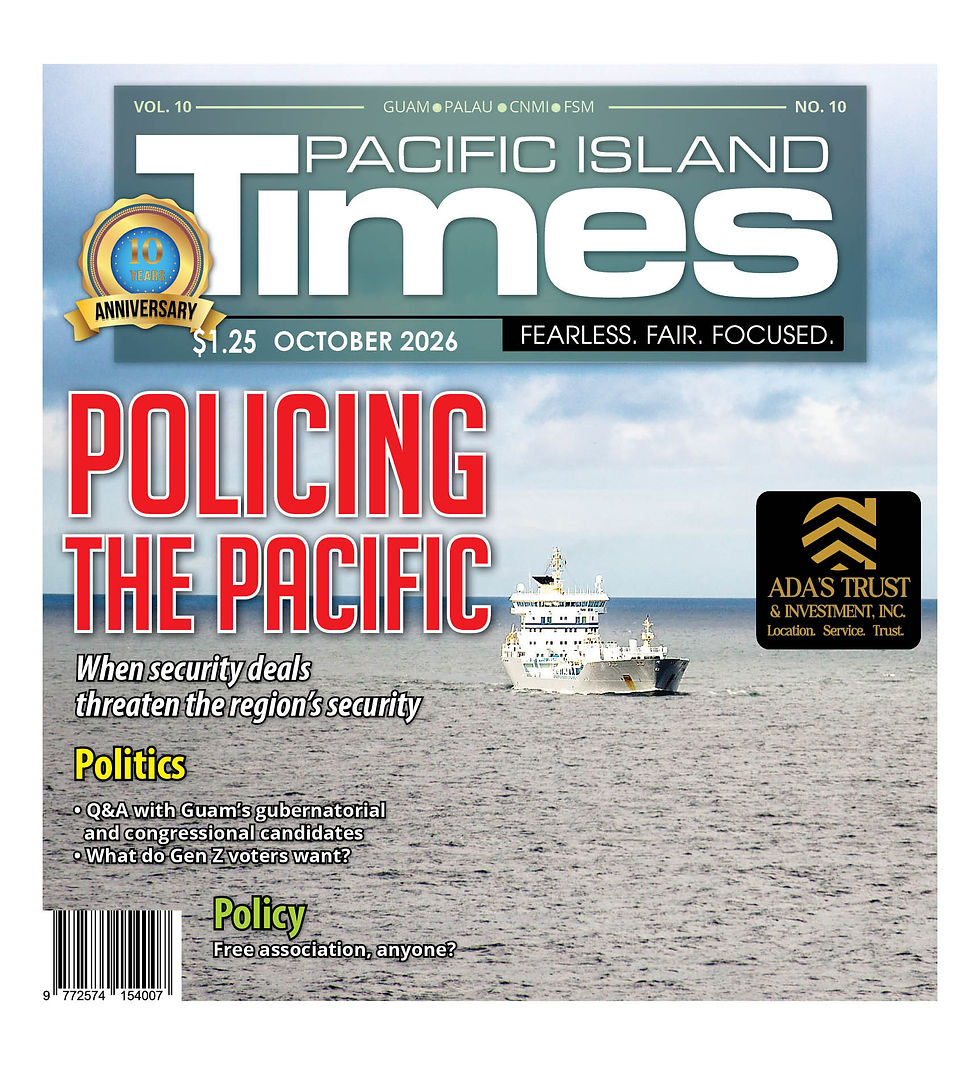
Subscribe to
our digital
monthly issue


