


Matrilineal roots: Women in Guam politics


By Alex J. Rhowuniong
Eight female candidates confronted the gap between Guam’s matrilineal traditions and women’s influence in modern government.
The candidates running for various positions discussed their views on reproductive health, LGBTQ+ rights, domestic violence, housing, economic empowerment and political self-determination at the University of Guam’s Famalao’an Candidate Forum on Oct. 22.
Hosted by the University of Guam Social Work Student Alliance and I Hagan Famalåo’an Guåhan, the forum highlighted the island's culture, which recognizes women as pillars of family and community life.
Over the years, Guamanian women have assumed leadership positions in the three branches of government, as well as in educational institutions and business organizations.
Women make up 16 of the 44 candidates running in Guam’s general election, according to UOG figures from the Social Work Student Alliance and I Hagan Famalåo’an Guåhan.
Their proposals offered voters a way to assess whether candidates would translate cultural respect into policies that address health care, safety, housing, jobs, and family stability.
Across Micronesia, culture, family and community responsibilities shape ideas about leadership. For Guam voters, the forum raised a practical question: Can women seeking office convert the island’s matrilineal heritage into political power, accountability and results?
Sen. Therese Terlaje, a Democrat running for governor, said Guam’s heritage influenced her approach to listening and decision-making. She emphasized the importance of having complete information before acting.
“Part of that is because I carry a huge responsibility, and before I exercise that, I want to be fully informed,” she said.
Terlaje also said timely information helps build consensus. But she acknowledged that women face a double standard in public life, including having their work claimed by others and their voices challenged.
“They will talk louder than you in a room,” Terlaje said. “They will try. And maybe they'll call you names.”
Her remarks highlighted a broader tension: traditions may honor women while institutions still limit their authority.
Cultural recognition matters, but it cannot replace equal opportunity to shape decisions affecting families, communities and nations.
The forum connected women’s leadership to practical concerns.
Senatorial candidate Louisa Borja said she would provide more resources to organizations assisting domestic violence survivors.
Incumbent Sen. Telo Taitague discussed funding for transitional housing, federal housing programs and job training to help survivors achieve financial independence.
Survivors need safe housing, services and opportunities to rebuild their lives.
On reproductive health, former Sen. Amanda Shelton said women should not have to wait months for a doctor or travel off-island for care. She proposed expanding telehealth and funding doulas.
ADVERTISEMENT

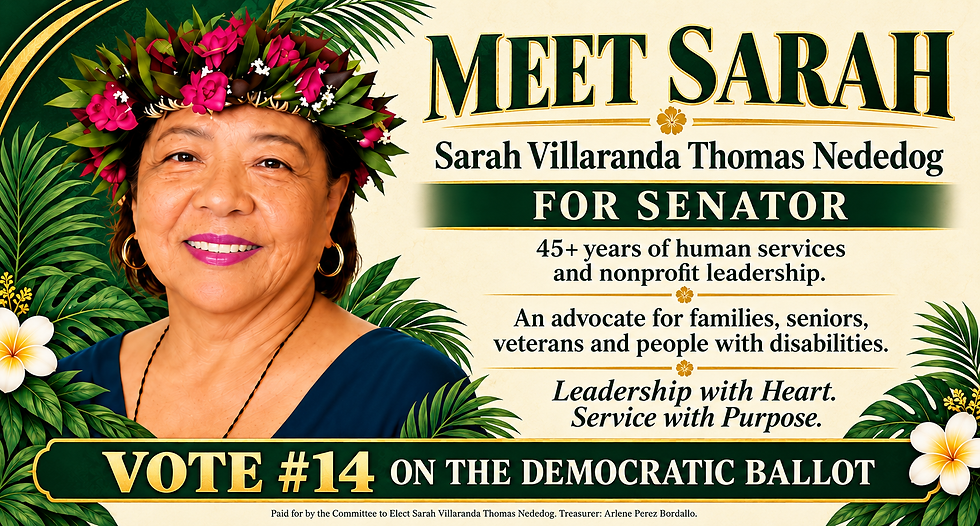
Senatorial candidate Sarah Nededog emphasized prevention, education and grassroots services, including more community-based social workers.
Kallen Perez discussed economic empowerment, including incentives for women to enter the Guam Contractors Association Trades Academy and expanded support for caregivers.
These proposals addressed health, safety, education, employment and economic independence. They are also community concerns: when women cannot access care, escape abuse or support their families, the effects reach children and extended family networks.
Sen. Sabina Perez, Terlaje’s running mate for lieutenant governor, discussed LGBTQ+ rights and protections for vulnerable young people, including safe spaces, mental health support, protection from discrimination and housing.
ADVERTISEMENT
Former Guam Attorney General Alicia Limtiaco, who is seeking the island’s congressional delegate seat, addressed political self-determination for Guam’s Indigenous inhabitants. She said she would pursue a legal path forward and advocate for the community’s decision.
Together, these issues raise a central question: How can government protect people’s dignity while respecting the community’s right to shape its future?
That question resonates across Micronesia, where communities navigate cultural identity, political status, public services and outside influence.
ADVERTISEMENT

Eight female candidates attended the forum: Terlaje, Sabina Perez, Limtiaco, Taitague, Borja, Nededog, Kallen Perez and Shelton.
Their participation gave voters a chance to hear how candidates would address issues affecting women and the wider community. But representation alone does not guarantee better policy or outcomes. Those depend on authority, resources and accountability.
Guam’s matrilineal heritage offers an important foundation for considering women’s leadership. It should not be treated as proof that gender inequality has disappeared or that women share identical priorities.
But the central question remains whether representation produces accountability: whether women in office can shape policy, answer to their communities and turn cultural respect into results.
Guam’s matrilineal heritage is not merely a symbol of women’s importance. It is a standard for leadership—one that demands participation, responsibility, and service. In the end, the forum opened that conversation; elected officials will be judged by the decisions they make and the promises they keep.

Subscribe to
our digital
monthly issue


