


Guam gubernatorial candidates outline competing plans to rebuild tourism


By Ron Rocky Coloma
Five gubernatorial teams presented competing plans to rebuild Guam tourism, but they converged on one central point: The island cannot market its way out of the industry’s prolonged weakness without first improving the destination visitors encounter.
During a tourism forum attended by nearly 500 people, the teams addressed four areas: governance, airline capacity and visitor demand, workforce and infrastructure, and market diversification.
Their proposals ranged from new tourism councils and Cabinet-level leadership to airline incentives, village investment, sports facilities, apprenticeships and expanded visitor markets.
The forum, hosted July 20 by the Guam Travel and Tourism Association at Rihga Royal Laguna Guam, placed the condition of Guam’s tourism product at the center of the 2026 gubernatorial campaign. Candidates repeatedly cited aging infrastructure, limited air service, labor shortages and declining market share in Japan and South Korea as interconnected problems requiring coordinated government and private-sector action.
Vice Speaker Tony Ada and running mate E.J. Calvo offered the most specific arrival targets.

Their “Tourism First” plan would create a chief of tourism and economic development reporting directly to the governor and coordinating agencies involved in roads, parks, taxation, economic development and aviation.
Calvo said the administration would seek to restore 1 million annual arrivals as an immediate priority, return to at least 1.5 million within four to five years and pursue 2 million arrivals over eight to 10 years. The team also proposed a comprehensive recovery plan with timelines, milestones and public reporting.
“Marketing alone isn’t enough. We have to improve the product we’re selling,” Calvo said.
The Republican Ada-Calvo team proposed cleaner parks and beaches, improved roads and sidewalks, upgraded historic sites, new sports facilities, family attractions, a revitalized Hagåtña and a Guam Cultural Center. It also called for hotel and attraction incentives tied to local hiring, training, beautification and visitor spending.

The rival Republican team, Speaker Frank Blas Jr. and Mary Okada, emphasized a whole-community approach built around communication and measurable agency plans.
Okada said every agency touching tourism should operate under a strategic plan with goals and key performance indicators.
Blas said government, businesses and residents must jointly shape the visitor experience rather than treat tourism as the responsibility of one agency. He also argued that improvements made for residents would strengthen Guam’s appeal to visitors.
“Let’s create that Guam experience together because, you know, the Guam experience is just as important for visitors, but more important for our families. It starts there,” Blas said.
Okada highlighted village partnerships, nonprofit management of community facilities, apprenticeships and Guam Community College programs.
She said businesses could use apprenticeship tax benefits while the government works to simplify burdensome application processes. She also suggested identifying excess revenues for a public-private investment fund guided by a tourism strategy.
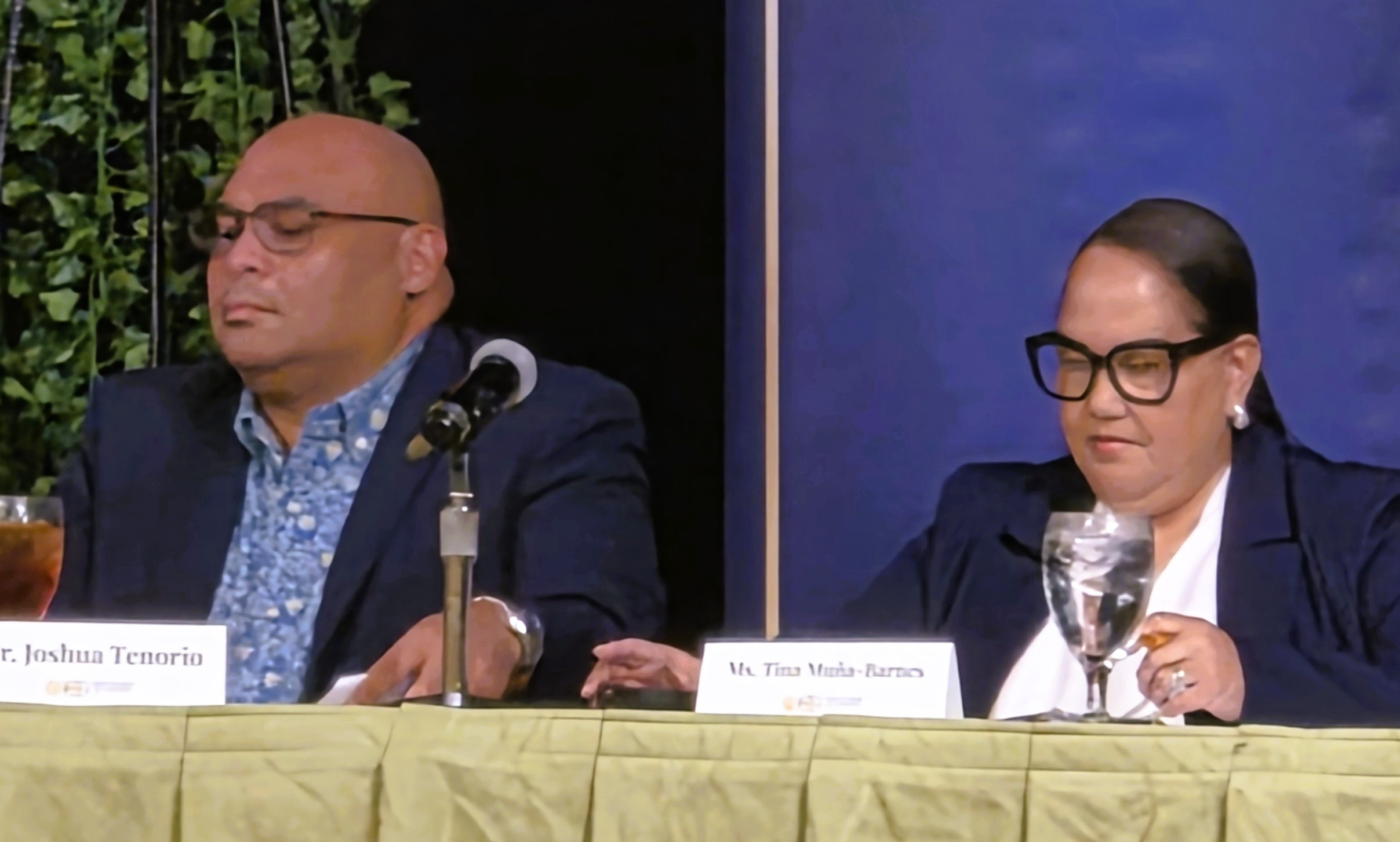
Lt. Gov. Josh Tenorio and Sen. Tina Muña Barnes focused on flexibility, federal partnerships and established tourism programs.
Tenorio said Guam must adapt to travel patterns that differ sharply from those of 10 or 20 years ago, including fewer Japanese passport holders and growing wealth in parts of Southeast Asia.
The team supported efforts to add the Philippines to the Guam-CNMI visa waiver program, improve electronic travel authorization processing and use airport leases of up to 50 years to strengthen airline partnerships and attract new service.
Muña Barnes called for development of cruise tourism, film, sports tourism and village attractions. She also pointed to apprenticeship expansion and legislation for a tourism charter school.
Tenorio proposed either a hospitality magnet school or charter school in Tumon to establish a direct employment pipeline. He also linked tourism recovery to broader investments in utilities, health care and public safety, including underground transmission lines and a new hospital.

Sens. Joe San Agustin and Dwayne San Nicolas proposed a “Unified Tourism Command” to coordinate agencies and private-sector partners.
San Agustin said the structure would bring government entities together regularly and move the private sector from consultation into policy design.
Their team supported airline incentives tied to high-potential routes, modernization of the qualifying certificate program and targeted development of medical tourism, meetings, conferences and exhibitions.
San Nicolas also argued that Guam should better connect military families with the local visitor economy while traditional Asian markets recover.
San Nicolas said military personnel and their visiting relatives could help sustain flights, businesses and attractions. He also called for long-term planning that looks beyond one election cycle.

Sens. Therese Terlaje and Sabina Perez centered their plan on data, environmental protection and measurable public accountability.
Terlaje proposed a governor’s tourism and stewardship council that would set goals, publish results online and direct agencies to address safety, cleanliness and transportation.
“This has to be led, and it’s going to be led by a governor’s tourism and stewardship council,” Terlaje said. “And it’s not an advisory council. It’s a council to measure progress, report on the progress and set the goals.”
The team proposed establishing foundational infrastructure priorities within the first 100 days and moving agencies toward those goals within 180 days. Terlaje also listed wastewater, stormwater, solid waste, erosion control, beach protection and the aquifer as tourism infrastructure.
Perez called for a permanent route-development team involving the Guam Visitors Bureau, airport, governor’s office and private businesses. She said airline incentives should support new or meaningfully expanded service with a realistic path toward commercial sustainability.
ADVERTISEMENT

On market development, the teams generally agreed Guam should protect Japan and South Korea while expanding elsewhere. The Philippines, Taiwan, Southeast Asia, Australia and New Zealand surfaced repeatedly. Candidates also discussed targeting U.S. citizens living in Asia and promoting Guam’s status as a U.S. destination.
Tenorio said Guam should pursue higher-spending travelers within existing markets. Ada and Calvo argued that Guam’s declining share of Japanese and Korean outbound travel showed the island had stopped competing effectively, not that those travelers had disappeared.
“Our problem isn’t that Japan and Korea stopped traveling,” Ada said. “The problem is that Guam stopped winning as a destination.”
Beyond geography, the forum highlighted diversification by purpose. Proposals included sports tournaments, education, culture, wellness, weddings, reunions, ecotourism, agrotourism, medical travel and meetings and conventions.
Perez said businesses must be easier to find and book online and proposed “tourism with a purpose,” including village festivals, outdoor heritage exhibits and experiences that encourage longer stays and local spending.
Calvo proposed a national baseball stadium, rugby pitch, public pools, beach volleyball and pickleball courts, a skate park and the return of motorsports. He said modern facilities would serve residents while creating opportunities for competitions and training groups.
Funding beyond the Tourist Attraction Fund also drew broad support, though teams proposed different safeguards. San Agustin favored performance-based matching tied to verified arrival growth. Perez listed cooperative airline and tour marketing, private matching contributions, federal grants, sponsorships and visitor-generated revenue dedicated to defined improvements.
Blas and Okada said existing agency spending could be aligned with tourism priorities, with excess revenue potentially supporting public-private projects.

Subscribe to
our digital
monthly issue


