Decolonization advocates imagine Guam as a sovereign state


By Jayvee Vallejera
As a sovereign state, Guam has bargaining power, charts its own path and manages the island's environment, according to decolonization advocates, who push for a change in the U.S. territory's current political status, noting its limitations.
Political sovereignty for Guam, in whatever form that may be, is a practical necessity to protect Guam’s environment, according to Clynt Ridgell, deputy chief of staff at the Office of the Governor of Guam.
Ridgell noted that local protests against environmental degradation caused by U.S. military activities are routinely sidelined by federal authorities.
“Ultimately, we have no say. They can look at our concerns. Read the concerns—'Thank you very much, duly noted’—They check a box and move on,” Ridgel said, speaking at the Hita La'mon: Toward Sovereign Futures decolonization conference at the Hilton Resort & Spa.
“Sovereignty would enable us to be able to actually address those concerns and actually have some say over it.”
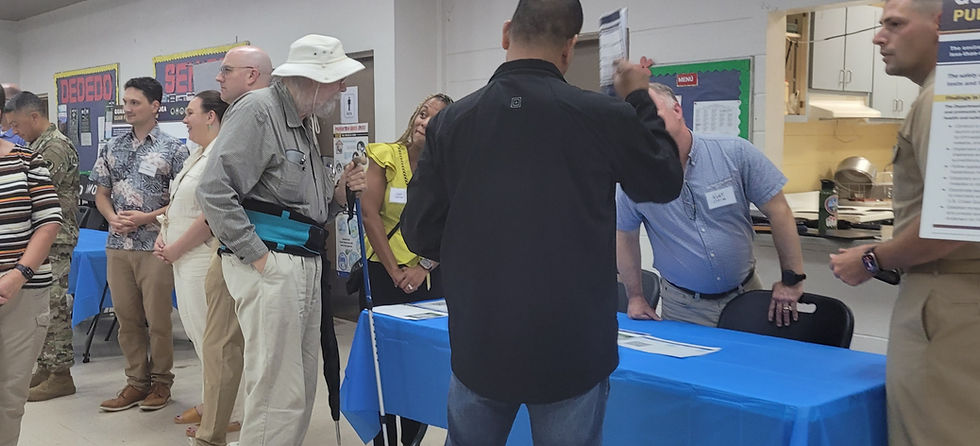
The Sept. 10 conference brought together policy and security experts to examine what a sovereign Guam would look like 10 years from now, focusing on two scenarios: either freely associated with the United States or independent.
The conference panelists tackled key questions regarding Guam’s self-rule, community safety, and the protection of lands and waters.
Ridgel noted that the freely associated states—Palau, the Federated States of Micronesia and the Marshall Islands—exercise their sovereignty by rejecting seabed mining in their exclusive economic zones, Ridgell said.
“Ten years from now, we would be able to develop our own (National Environmental Policy Act) processes for construction. Ten years from now, we would be able to say no to seabed mining,” he added.
Currently, he added, local protests don't carry weight since “the actual decision makers are in D.C. They're separated from the noise down here.”
In a yet-to-be-scheduled political status plebiscite, Guam voters would choose among three options: statehood, independence, and free association.
Guam is currently an incorporated territory, where the Insular Cases doctrine applies.
ADVERTISEMENT

To transition to full autonomy, Ridgell suggested adopting regional models like Palau’s “green fees,” which fund local conservation efforts.
Ridgell also cited the Trump administration's efforts to defund the federal EPA as a “wake-up call” to build local revenue sources.
“A lot of people, when they think about sovereignty, one of the arguments against sovereignty is this idea that you're going to lose all your federal money if you become sovereign. That's not true,” he said.
He pointed out that Israel is a sovereign nation, yet get lots of federal money from the United States. The same is true for COFA nations like FSM, the Marshall Islands and Palau.
“Because we're sovereign, we can negotiate with the federal government the terms of different things, like having a military base on the island or whatever the terms are and be able to negotiate for federal dollars while we also strengthen our economy and create our own revenues,” he added.
Regarding Guam’s security, Leeland Bettis, director of the Pacific Center for Island Security, argued that relying on the United States for defense is a flawed view that undermines genuine island security.
“Without sovereignty, someone else is making decisions about your security, and I would argue that's not a very secure future for Guam,” Bettis said. “We have to get beyond believing when someone else says that we're providing you security, that they’re actually providing you security. They're thinking about ‘their’ security.”
A sovereign Guam, he said, would allow the island to shape its security that meets its actual needs.
“We need to begin to think about new ways to structure security as opposed to relying on the old ‘I have the biggest missile’ idea of what security represents,” he said.
ADVERTISEMENT

Bettis also called for building and strengthening local diplomatic capabilities to engage directly with neighboring countries.
Bettis was cynical about the environmental protections the military’s NEPA process has afforded Guam.
“What has NEPA really done for us? We have PFAS. We have the dieldrin,” he said. “At the end of the day, NEPA hasn't protected our most precious, basic foundational element of living, which is water.”
Fernando Estevez, deputy director of the Guam Housing and Urban Renewal Authority, said the primary obstacle to sovereignty is psychological rather than structural.
He said what’s needed is a psychological shift among Guam’s people.
Citing the Solomon Report, which the U.S. government drafted in the 1960s, Estevez said it was a blueprint intended to make U.S. territories dependent on the United States.
“This has been a core strategy…keep them just dependent enough, provide just enough, and you'll hold them in compliance. They'll be manageable and you have control,” Estevez said.
Estevez said any path toward sovereignty must prioritize basic needs, especially housing and food security, to ease the public’s fears and anxiety.
Citing Singapore’s experience after becoming independent, Estevez urged local leaders to build government policies around core community values, high-tech industries like data management and subsea fiber optic infrastructure.
“You cannot subsidize your way to prosperity,” Estevez said. “True sovereignty always means self-sufficiency. Sovereignty without autonomy, sovereignty without agency, is just colonialism in another form.”
The panelists were optimistic that political self-determination for Guam is well within reach, provided the community actively works toward that goal.
Ridgell noted that, unlike the violent revolutions of the past, many of Guam’s Pacific neighbors were able to transition to different political statuses through negotiations and diplomacy.
“Decolonize our minds first and start thinking in a different mindset in a different framework,” he said. “The risks are minimal. The risks are really just being willing to do the work. Sovereignty is a lot more attainable than we think. And I think the proof is all around us.”

Subscribe to
our digital
monthly issue