


A coastal burden reimagined: How seaweed could support Pacific construction


By Bryan Manabat
As U.S. Pacific territories search for ways to reduce construction costs and manage growing volumes of coastal waste, a French researcher’s proposal to turn stranded seaweed into building materials offers an unexpected possibility: that the same biomass washing ashore in Brittany might one day help build homes in Saipan, Guam, or Palau.
That idea comes from David Terradot‑Piot, a trainer in construction materials at Unicem Campus in Brittany, who is studying whether marine biomass typically treated as a coastal burden can be transformed into a safe, predictable construction resource.

In a report shared with Pacific Island Times, Terradot‑Piot describes the work as “deliberately exploratory,” emphasizing that the goal is not to rush seaweed into concrete but to understand the material from the ground up.
“The first objective is to understand the material itself: its variability, its salts, its mineral fraction, its organic content and any contaminants that could prevent safe use,” he writes. “Only after that characterization can a realistic construction application be discussed.”
The project examines algae from two very different environments: green algae collected along the Atlantic coasts of Brittany and Normandy, and Sargassum gathered in the French Caribbean. Terradot‑Piot notes that “a green alga from an Atlantic beach and Sargassum collected in the Caribbean cannot be treated as identical resources,” underscoring the need for adaptable methods rather than a universal recipe.
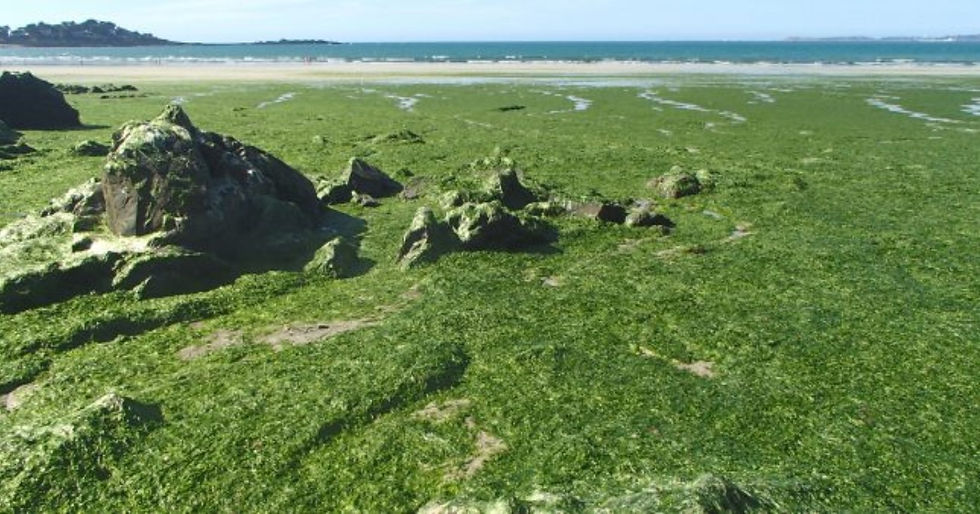
Before any mechanical testing, the biomass must be washed, desalinated, dried and sometimes thermally treated. “Chlorides are particularly important in construction,” he explains, because excessive chloride content can be incompatible with cement and can accelerate corrosion in reinforced concrete.
The project also evaluates how undesirable elements — including arsenic, which may be present in some marine algae — behave during treatment. “Environmental safety has to be considered at the same level as mechanical performance,” Terradot‑Piot said.
If the treated biomass proves stable and predictable, several construction pathways could be explored. These include using seaweed as a filler, a processed ash, a carbon‑rich additive or a secondary constituent in cementitious materials. Road‑base applications may also be possible. “A material that proves unsuitable in one application may still have value in another,” he notes.
The concept resonates strongly in the Pacific, where island territories face similar coastal management challenges and heavy dependence on imported construction materials. Guam, the Northern Mariana Islands, Palau and the Federated States of Micronesia all contend with limited land availability, sensitive coastlines and high shipping costs for cement, steel and aggregates.
“In that context, even partial recovery of a locally available material can become interesting — provided that it is safe, technically credible and economically realistic,” Terradot‑Piot writes.
Pacific researchers have explored related ideas. Studies in Hawaii have examined limu as a bio‑based building material. In Mexico, companies have produced Sargassum‑based blocks and concrete alternatives. Other research has tested seaweed insulation boards and alginate‑enhanced unfired bricks, which can reduce embodied carbon.
For Pacific territories, the appeal is clear: locally sourced materials could reduce shipping costs, support circular economies, and provide new options for post‑typhoon rebuilding. Even small‑scale use — such as fillers, insulation or non‑structural components — could ease pressure on supply chains.

But Terradot‑Piot cautions that marine biomass is far from becoming a mainstream construction material. “A residue only becomes a resource when its properties are understood and controlled,” he writes. Variability among species, seasons, and collection points means that any future use would require strict quality control.
The next steps, he says, belong in the laboratory: washing, characterization, controlled treatment, formulation and testing. Only then can researchers determine whether seaweed collected from Pacific beaches might one day find its way into local construction.
For island communities balancing coastal management and construction supply challenges, the question is worth exploring — and the answer may help shape future resource strategies from Brittany to the Pacific.

Subscribe to
our digital
monthly issue


