


‘Pressure Points’ exhibit on Guam highlights printmakers, global collaboration


By Ron Rocky Coloma
What began as a shared conversation among printmakers from different parts of the world has taken shape on Guam through “Pressure Points,” an international exhibition that explores how art can carry the weight of lived experience.
Opening March 28 at the Guam Museum Café Gallery, the show brings together the Magenta Research Collective, a group of female printmakers whose work spans continents and approaches, from figurative to abstract and experimental.
The exhibition also doubles as a milestone for local students, marking the culmination of a yearlong Guam Economic Development Authority internship program focused on gallery work and professional exhibition skills.
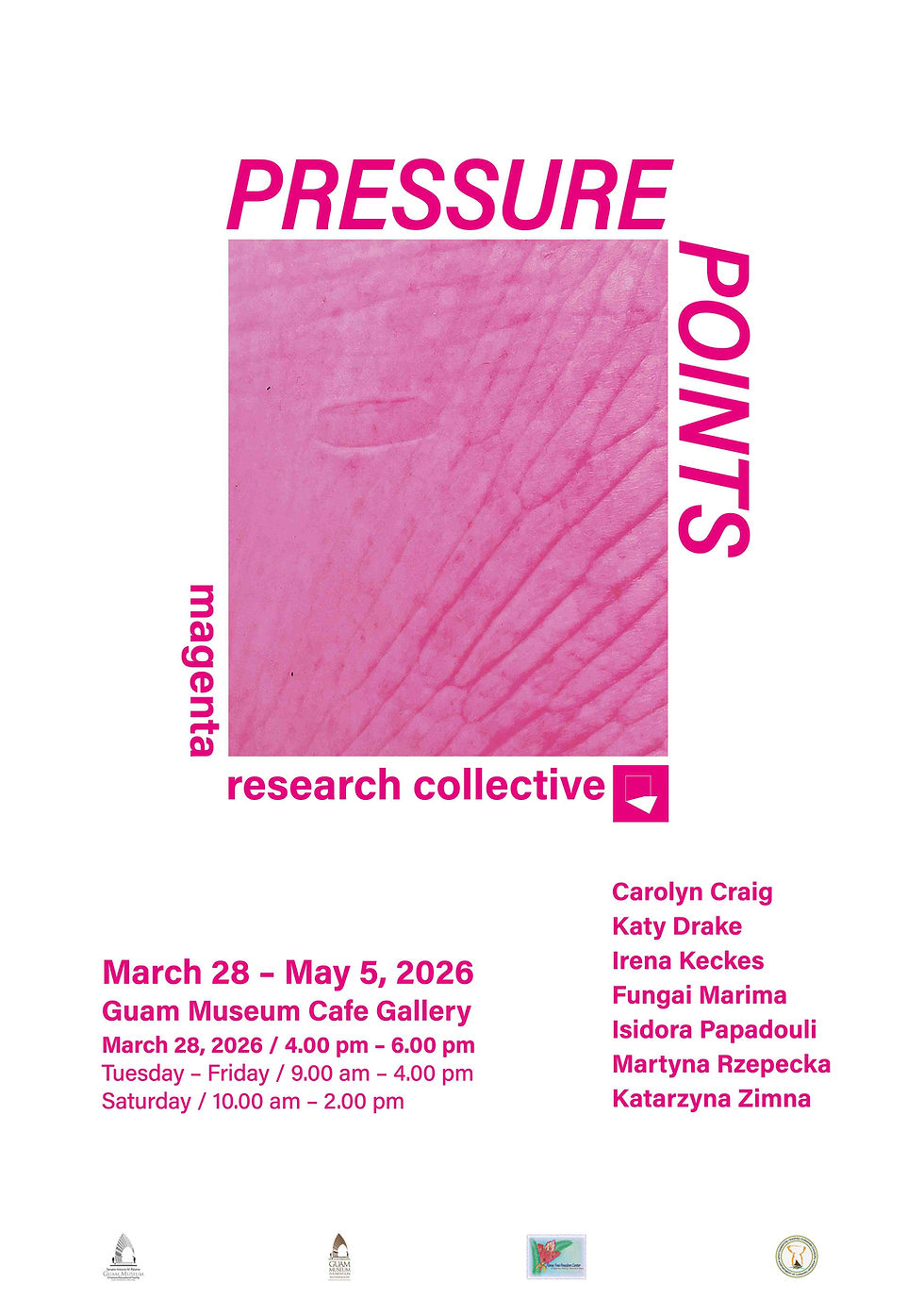
The collective traces its roots to the IMPACT 12 printmaking conference in Bristol in 2022, where the artists first connected through shared research interests around feminist themes and the body. Since then, they have continued collaborating across countries through exhibitions and publications.
“The themes of our research have many common and touching points, such as exploring feminine and feminist topics through diverse stories and artistic expressions,” said Irena Keckes, a University of Guam professor of fine arts and the group’s local representative.
At the center of the exhibition is the idea of pressure, both as a physical force in printmaking and as a metaphor for cultural and social tensions.
“Magenta Research Collective’s ‘Pressure Points’ collaborative exhibition is focused on engaging in a dialogue about the boundaries of print as material and the matrix itself,” Keckes said. “It explores how the body, materiality, connection and touch intersect.”
Through processes like pressing, layering and imprinting, the artists examine how identity and experience take shape over time.
“These processes mirror how identity and the body are formed through
accumulation, pressure, and trace," Isidora Papadouli said.
For Polish artist Martyna Rzepecka, the concept is deeply personal and physical.
“The title prompted me to reflect on where the tension accumulates in doing art,” she said. “The cutting is, for me, an intimate moment and kind of a meditation.”
She described printmaking as a direct interaction between body and material.
“This is a moment when my body works with the graphic skin, a matrix, where I leave an invisible body print,” Rzepecka said.
Other works in the exhibition expand that idea into broader narratives. Zimbabwean artist Fungai Marima presents a performance archive exploring grief.
“I was drawn to the idea of visualizing moments in time, the points of impact that help us understand our environments,” she said, describing her work as capturing “a snapshot into the process of grief.”
Across the exhibition, artists reflect on themes that cross geographic and cultural boundaries, including the body, identity and systems of power.
“We want viewers to feel the energy and strength of women artists,” said Katarzyna Zimna. “These are experiences that, despite geographical and cultural differences, concern all of us.”
The medium itself also plays a role in shaping those conversations. Carolyn McKenzie Craig emphasized the collaborative nature of printmaking spaces.
“A print studio is a visual machine whose parts include both the presses and the inks as much as the bodies and breath that share the space,” she said. “The political leaks into everything we do.”

Subscribe to
our digital
monthly issue


