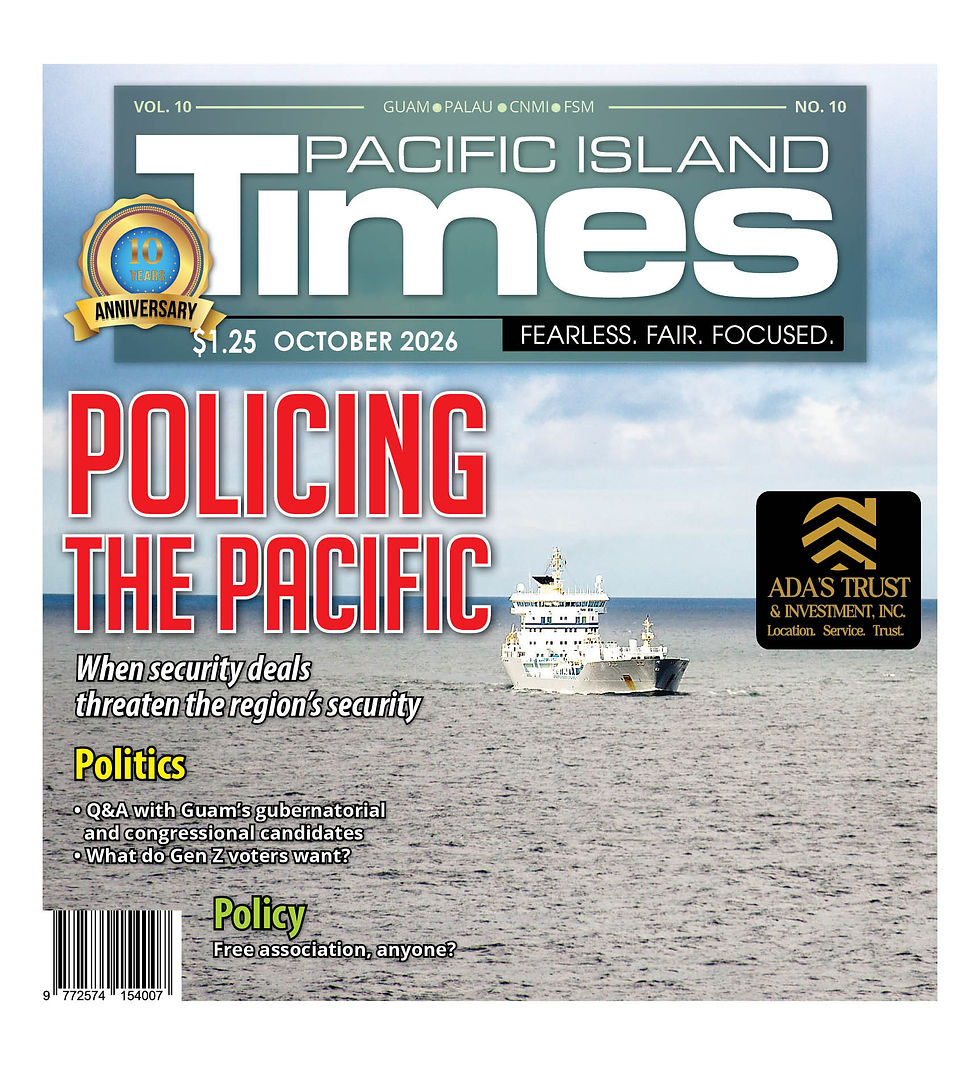
Policing the Pacific: Leaders seek a cohesive response amid fragment security framework


By Mar-Vic Cagurangan
China’s growing police presence in the Blue Pacific is changing the region’s security landscape, requiring a balancing act for the islands receiving assistance, while causing anxiety among their traditional partners, including Australia, New Zealand and the United States.
Opportunism and pragmatism mark China’s approach in the Pacific, according to security experts.
"Engagement has often accelerated in moments of unrest or political crisis, when governments face acute public order challenges,” reads the 2026 report released by the Global Initiative Against Transnational Organized Crimes, a Geneva-based international nonprofit organization.
“Offers of assistance are typically framed as respectful of sovereignty and free of governance conditionality, and yet frequently tied, explicitly or implicitly, to the protection of Chinese nationals and businesses,” states the report.
The Solomon Islands—whose secretive security pact with Beijing was leaked in 2022—has reset its framework under the South Pacific island nation’s pro-Australia prime minister, Matthew Wale, who has negotiated a new “comprehensive” security and economic treaty, which awaits signatures.
The security treaty between China and the Solomon Islands worried the Pacific island states, including Beijing’s diplomatic allies, due to speculation that it granted the People’s Liberation Army the option to send Chinese forces into the region, where the communist nation is involved in illegal, unreported and unregulated fishing.
When Wale survived a no-confidence vote in parliament last month, Australian Prime Minister Anthony Albanese vowed to accelerate the new agreement he hoped would replace China’s security package negotiated by the previous Solomon Islands administration.
Washington is not to be outdone.
During his 10-day Pacific tour, Christopher Landau, deputy secretary of the Department of State, met with Wale in Honiara to begin discussions on an economic and security partnership.
“We can be a strong partner of the Solomon Islands and that we can engage the Solomon Islands on the basis of transparency, collaboration, and in the spirit of equal partnership,” said Matt Murray, the department’s deputy assistant secretary for Australia, New Zealand and the Pacific Islands.
In July, the U.S. Coast Guard signed a shiprider agreement with the Solomon Islands, granting law enforcement officers from both countries mutual authority to operate aboard each other’s vessels to enforce maritime laws, patrol the ocean, monitor poachers and combat illegal activities. The U.S. Coast Guard has similar agreements with Palau and the Federated States of Micronesia.
Murray said the U.S. Coast Guard plans to increase its presence in the Pacific by entering into more shiprider agreements with other Forum members.

The Pacific island region is confronted by growing security challenges, including transnational organized crime, illegal and unregulated fishing, climate change, humanitarian emergencies and economic disruption.
In August, Kiribati detained a Chinese vessel for illegally harvesting shark fins. The practice of cutting fins off live sharks and throwing the carcasses back into the sea is banned in much of the Pacific Ocean, but persists due to demand in East and Southeast Asia.
The Chinese ship was among four vessels detained during a surveillance crackdown by 11 Pacific island nations from Aug. 3 to Aug. 14, with assistance in some areas from the U.S. Coast Guard and an Australian military aircraft.
“I would say that the United States certainly shares concerns with our Pacific island partners related to China’s malign activities in the Pacific, which include IUU fishing, elite capture and corruption, economic coercion, environmental degradation, and, as you mentioned as well, provocations like the recent (missile test) launch,” Murray said during a virtual press briefing on Sept. 20.
He said Washington is pushing law enforcement cooperation and maritime security with the Pacific “to stop the flow of illicit drugs, enhance maritime domain awareness and combat illegal, unreported and unregulated fishing.
These are pressing challenges impacting the safety, security and prosperity of Americans and Pacific islanders.”
During his meeting with Forum leaders in Palau, Landau unveiled a $17 million Pacific Regional IUU Fishing Project to curb poaching in the Pacific islands.
Murray said the project focuses on legal support to update national laws, policies and regulations “to align with regional IUU fishing strategic objectives, develop training programs and deploy new technologies.”
The Global Initiative report also listed Tonga among the Pacific island countries familiar with the balancing act of managing relationships with multiple policing partners. The Polynesian kingdom also receives support from policing partners as diverse as Australia and the United Arab Emirates.
Vanuatu has a long-standing commitment to its nonalignment and neutrality, and a history of engagement with multiple partners including Australia, the U.S. France, New Zealand, Japan and China. In 2025, amendments to the National Security Act required foreign advisers working in the national security sector to be based at neutral venues or at their respective embassies.
In Samoa, China built a new Police Academy in 2024 as part of its Belt and Road Initiative, representing the most visible manifestation of Chinese security assistance to the South Pacific nation.
Multiple agreements complicate the region’s security and law enforcement framework, which consequently becomes fragmented. Security pacts, while intended to address security issues, can breed new threats, such as rising geopolitical tensions and strategic risks.
At the conclusion of the leaders’ meeting in Palau, the Forum endorsed a new regional peace and security action plan that would provide “a cohesive architecture” to strengthen coordinated responses to various traditional and non-traditional security challenges facing the Pacific region.
The Forum underscored the importance of collective action to address traditional and non-traditional security challenges by enhancing intelligence sharing, coordination and maritime security cooperation.
“Leaders endorsed the Regional Peace and Security Action Plan 2026-2030 to advance regional peace and security priorities and emphasized the importance of member-led implementation that is responsive to differing national
circumstances and capacities, appropriately prioritized and adequately resourced,” reads the communique.
“It is precisely in times such as these that regional ownership matters most,” said Rick Houenipwela, chair of the Forum Foreign Ministers Meeting.
ADVERTISEMENT

While noting the merits of the island states’ partnerships with donor nations, Houenipwela emphasized that the region’s agenda “must continue to be conceived by the Pacific, shaped by the Pacific and owned by the Pacific,” a formula that he said built the bloc’s “strategic strength.”
Later this year, the inaugural U.S.-Pacific Islands Conference of Police Ministers will be held in Palau to discuss maritime security, drug trafficking, cybercrimes and illicit finances.
“Strong U.S. ties with the Pacific make our country and the region safer, stronger and more prosperous. The United States stands ready, willing and eager to deepen our partnerships in the Pacific and will continue to show up in the region,” Murray said.
“We’re not simply engaging the Pacific because of a desire just to deter or oppose China, but really because we want to, as the United States, have better relationships with these countries, which are so important to our own security and our own prosperity at home.”
Subscribe to
our digital
monthly issue