Military buildup in Palau faces growing dissatisfaction, report says


By Jayvee Vallejera
The guardrails built into agreements between the United States and Palau to protect the Pacific nation's environment and preserve its sovereignty are rendered ineffective by the accelerated military buildup, leaving Palauans out of the loop, according to a new report by the Guam-based think tank Pacific Center for Island Security.
The Micronesia Security Outlook 2025 report raises new questions about the U.S. military's presence in Palau.
Jodean Remengesau, who authored the Palau segment of the report, said that although the Compact of Free Association grants the U.S. military exclusive use of Palauan land, waters and airspace and allows the installation of military infrastructure, the treaty requires that environmental standards be met.
“The U.S. military had missed and fell short of fulfilling its duties and responsibilities under the compact of the U.S. with Palau,” writes Remengesau, director of the Bureau of Agriculture of Palau’s Ministry of Agriculture, Fisheries and the Environment.
In one instance, he said the U.S. military cleared land in Angaur, one of the 16 states of Palau, for the first site of its tactical mobile over-the-horizon radar system without obtaining an environmental earthmoving permit or conducting community consultations, as required by Palauan law.
“The piles of shredded tree debris inviting invasive coconut rhinoceros beetle infestation at (the radar site) were later dumped on residents’ yards in a rushed effort to deal with the problem, an issue that the environmental stipulations in the compact were designed to prevent,” the report says.
In 2023, Angaur Gov. Steven Salii sued Palau’s central government, the Palau Environmental Quality Protection Board the U.S. government and its military contractors, alleging violations of Palau environmental laws and compact agreements, for the clearing 271,807 square meters of land in the state without conducting an environmental impact assessment and obtaining permits before disturbing the property.
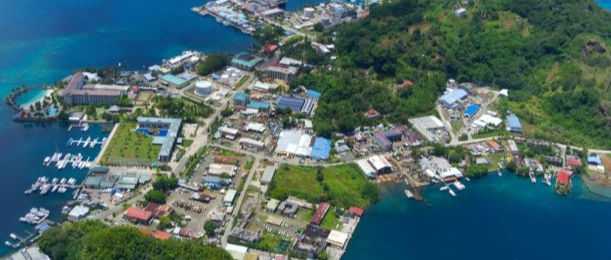
The report concedes that Palau’s current geopolitical position may increase the nation’s involvement in U.S. and international security objectives. Under the renegotiated compact, the U.S. pledged an $890-million package to Palau over 20 years. The cycle began on Oct. 1, 2023. The compact also provides for the United States' defense of Palau. Since a large portion of Palau’s national budget comes from compact funds and foreign aid, the military is anticipated to make further use of Palau.
“The island nation’s peace and sovereignty as its people once knew it has been increasingly compromised by accelerated militarization, but the potential for this has long been there,” the report says.
The geopolitical tension between the U.S. and China set the stage for recent military activities in Palau. The U.S. military's $118 million radar project is expected to be up and running this year.
The installation of a shoreline radar tower system, initially presented as a single infrastructure for mutual use by Palau and the U.S. military, later turned out to be two separate systems—one for the Palauan government’s use and another, the TACMOR system, for exclusive military use, the report says.
“Palau had become a distinct U.S. chess piece played on the Indian and Pacific Ocean chessboard against China,” the report says. “It has inadvertently made Palau a target for China.”
The report states that plans for the system had gone through national leadership and landowners, but without the full, prior and informed consent of the Palauan people—a gap that has led to resistance, with some calling for increased transparency and consultation. The report also highlighted a growing grassroots demand for enhanced protection in case Palau faces attacks as a result of this increased militarization.
The dredging of the Malakal Port, Palau's only commercial harbor capable of accommodating large vessels, including military warships, has drawn public scrutiny. The project involves increasing the port's storage and operational capacity for joint military and commercial use.
Another project that raised concerns for the Palauans is the planned airstrip and dock in Peleliu, which will serve as a Marine Corps base. “In a closed-door deal in mid-October 2025, one that did not include any Peleliu residents, the Peleliu State Public Lands Authority and state leadership sold Peleliu lands worth $11.8 million to the national government, which then, in turn, awarded it to the U.S. military for indefinite use,” the report says.
ADVERTISEMENT

The U.S. military has also begun rebuilding the former Japanese naval runway in Peleliu to accommodate military aircraft, adding fuel to the mix.
The renewal of compact agreements came with greater U.S. military involvement in Palau, the report says, citing a visit by a top-ranking military official in 2018. U.S. Navy Admiral Philip S. Davidson's visit was soon followed by the largest U.S. Army exercise ever held in Palau, the launch of the radar surveillance systems and the creation of the U.S. Task Force Oceania, a unit tasked with building positive relationships between the military and the local civilian population.
Palauans initially welcomed military traffic, but the rapid influx of troops quickly strained domestic resources and damaged roads, causing anxiety among residents.
The report says details of visits by ranking military officials, including U.S. Defense Secretary Mark Esper in 2020, were never disclosed to the public.
“Somehow along the chain of command, the U.S. ultimately decided to operate under the umbrella of the compact to advance their mission, but the agreements Palau and the U.S. struck years ago carry important guardrails, like due process, that should be followed,” the report says.

Subscribe to
our digital
monthly issue