


Died once, buried twice: Why Some Pacific Islanders dug up their dead


Imagine this. Someone’s grandmother dies. The family holds a funeral. Family members cry, talk, eat and eventually go home. Then, several months later, someone says: “Okay, time to dig grandma up.”
That may sound terribly wrong and creepy, but in many Pacific island societies, the burial was not the final step and death did not mean the end of a person’s relationship with their family.
The dead would be buried, then exhumed after the body had decomposed. The bones would be cleaned and reburied. Archaeologists call this secondary burial. This practice shows how different Pacific societies view what happens after death.
Let’s look at some examples.
The funeral after the funeral: One of the best-known examples of this practice comes from Aotearoa New Zealand.
In ancient Māori tradition, the dead were buried in shallow graves or placed in caves, trees or other secret locations.
The waiting period between burial and exhumation was necessary to allow the body to decompose before a spiritual leader returned to the grave to collect the bones.
During the ceremony called “hahunga,” the bones were cleaned, scraped and painted with red ochre. The bones were then taken to a sacred meeting place where family and community would gather for a feast and hold another period of mourning. Afterward, the bones would be buried in a secret place to prevent enemies from finding and disturbing the burial.
The hahunga ceremony was not only about digging up the dead but also about connecting the living.
About 3,000 years ago, people in Vanuatu who were connected to the early Lapita culture engaged in a similar practice.
In a Teouma cemetery on Efate Island, archaeologists found evidence that the dead were initially buried and later, their skulls and other bones were removed and buried elsewhere.
Archaeologists noticed the same sequence: burial, decomposition, digging up, moving the bones and secondary burial. Not every burial was treated the same. How the burials and bones were treated may have depended on the deceased's social status.
Second life for the bones: In Papua New Guinea, archaeologists found another variation of the practice. A 2026 study by Simon Coxe and Ben Shaw, “The Bones of Relation: Materializing Personhood Through Secondary Burial in Papua New Guinea,” examined nine burial sites in the islands of Panaeati and Pana Vara Vara.
Researchers found over 1,200 skeletal fragments from 166 individuals. The bones, skulls, teeth and jaws were rearranged and placed in caves and niches.
The researchers also found pottery, shell ornaments and other important objects among the remains. Archaeological evidence suggests that people in this region have practiced secondary burials for hundreds of years and continue to do so today. For them, the dead were still connected to the living.
Journey after death: Let’s head to the Solomon Islands where the story gets even more interesting. The Australian Museum describes a pre-Christian family tradition of keeping the body of a deceased loved one for several weeks before removing the skull, which was later washed in the sea and eventually taken to its burial place.
If the deceased was a chief, a priest or anyone of important status, the skull would be entombed in a burial structure with a wooden figure.
Traditions vary among islands and families in the Solomon Islands.
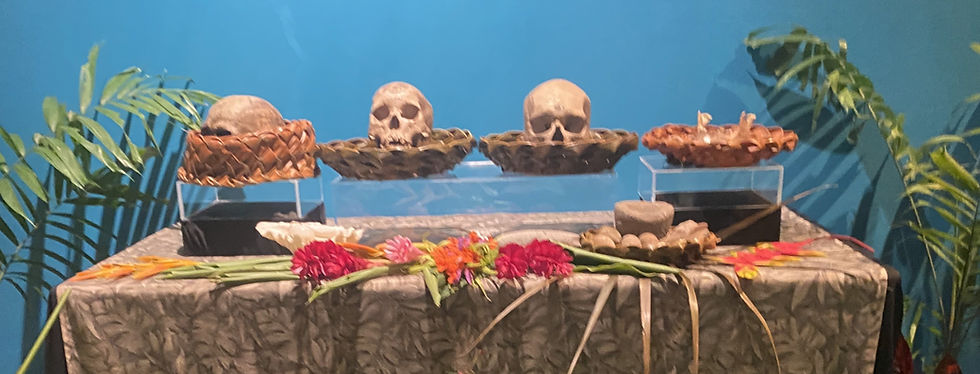
The skulls come home: In the Mariana Islands, the ancient CHamoru people had a similar tradition. According to Guampedia, after a deceased person was buried and the body had decomposed, the family removed the skull, cleaned it and kept it in their home.
The skulls were treated as part of the family because the CHamoru people believed the ancestor’s spirit remained connected to the skull. The family members would talk to the skulls, offer them food and drink and ask for guidance or good fortune.
Fishermen might ask the skull of an ancestor, who was a known fisherman, to help them catch plenty of fish.
ADVERTISEMENT

Islanders also asked their ancestors for help with planting crops, traveling, going to war, or other important activities. Traditional healers, called "makahna," used the skulls in prayers and rituals.
For many of us, the thought of keeping grandma's skull in the house may sound bizarre and horrific, but for the ancient CHamoru people, it was a way to stay connected to the family member who had passed away.
Today, we typically see a funeral as the final goodbye. A person dies, the body is buried and the grave becomes their final resting place. We may keep visiting the grave, but eventually, our lives go on without them.
Raquel Bagnol is a longtime journalist. She worked as a reporter for Marianas Variety on Saipan and Island Times in Palau. Send feedback to gukdako@yahoo.com
Subscribe to
our digital
monthly issue


